Trusted by Growing Brands

Total Control Over Your Warehouse Operations

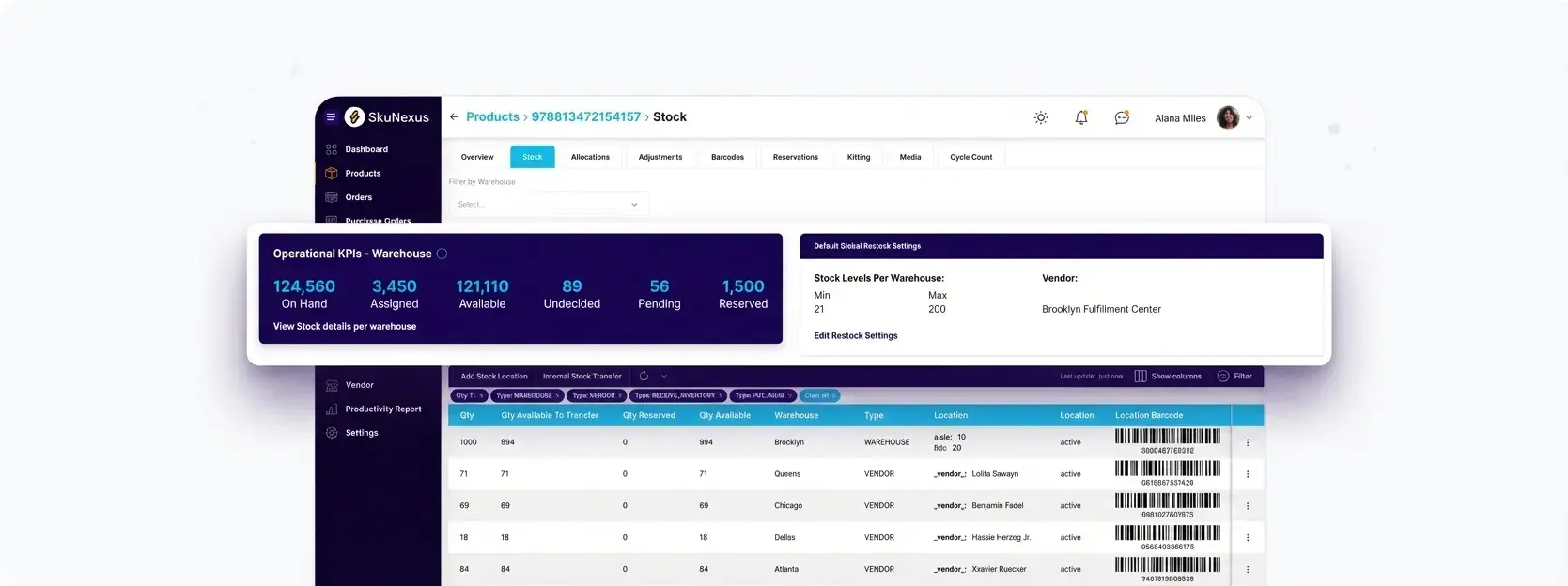
From receiving to putaway to cycle counts, SkuNexus WMS gives you complete visibility and control over every item in your warehouse. Access everything from any device with a browser.
No credit card required Free personalized demo Live in as fast as 2 weeks
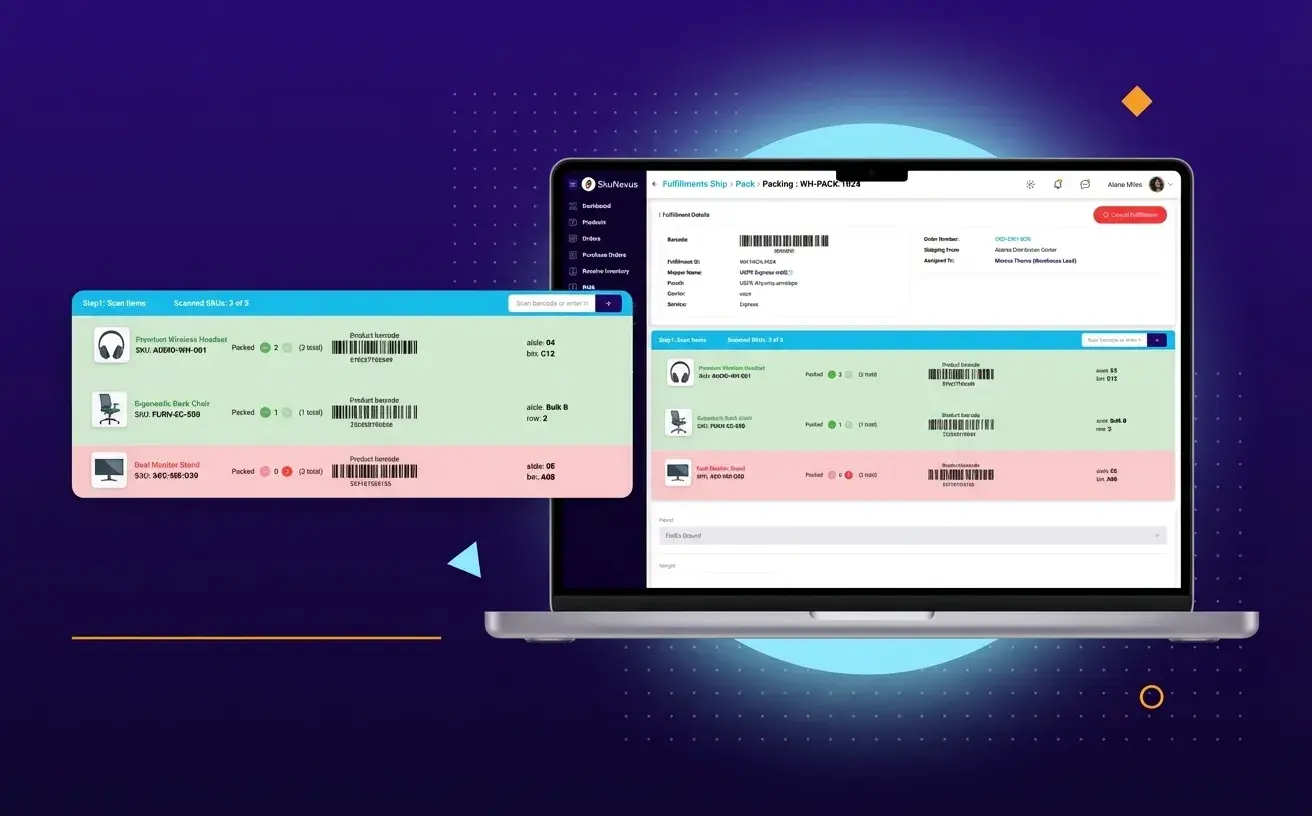
Warehouse Management — SkuNexus product screenshot
What Is It

What is a Warehouse Management System?

A warehouse management system (WMS) is software that controls and optimizes the movement and storage of goods within your warehouse, from the moment inventory arrives until it's ready to ship.

WMS software manages the core warehouse processes that happen before an order is picked: receiving shipments, sorting and inspecting goods, organizing putaways, managing bin locations, and conducting cycle counts. Without a WMS, these processes rely on memory, paper, and guesswork. With one, every item is tracked, every location is known, and every movement is recorded.
For growing eCommerce operations, a WMS eliminates the chaos of disorganized warehouses. You always know what you have, where it is, and whether it's in the right place. That foundation makes everything downstream, from picking to shipping, faster and more accurate.
See How It Works
25%
average inventory accuracy improvement with WMS (Aberdeen Group)

Key Capabilities

  • Receiving and inspection workflows
  • Intelligent putaway rules
  • Zone and bin location management
  • Cycle counting and inventory audits

Trusted by leading brands processing millions of orders
SN_TCM SN_Graeters SN_newlook SN_Carewell SN_DPP
★★★★★ 4.8/5 on G2 ISO 9001 Certified GDPR Compliant
The Challenge

Sound Familiar?

"We received 500 units yesterday and still can't find half of them."

Without proper putaway processes, inventory disappears into the warehouse. Your team wastes hours searching for items that should be easy to find.

Lost Inventory

"Our inventory counts are never right. We did a full count last month and it's already off."

Without regular cycle counts and location tracking, accuracy degrades quickly. Phantom inventory leads to oversells and stockouts.

Inaccurate Counts

"Receiving takes forever. Shipments sit on the dock for days before they're put away."

Manual receiving processes create bottlenecks. The longer inventory sits unprocessed, the longer it's unavailable to sell.

Slow Receiving

There's a better way

SkuNexus WMS brings structure to your warehouse. Receiving is streamlined. Putaways are directed. Every item has a location. Cycle counts keep accuracy high. Your team stops searching and starts executing.

See the Difference
How It Works

How Warehouse Management Works in SkuNexus

1

Step 1: Map Your Warehouse with Bin Locations

Every physical location in your warehouse gets a digital address in SkuNexus. Aisles, racks, shelves, bins — each mapped with a scannable barcode. You define zones (bulk storage, pick-face, returns, quarantine) and assign rules for what goes where.
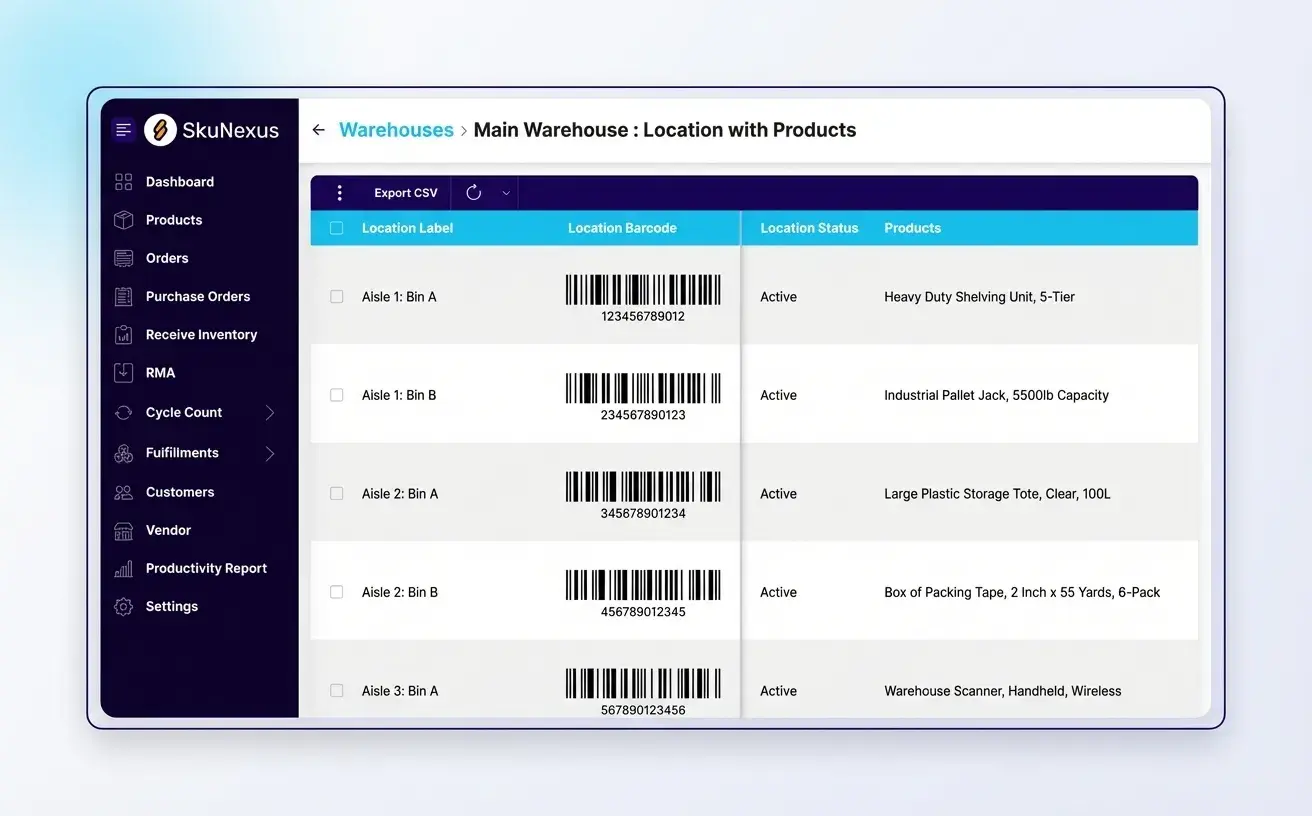
Warehouse bin location management
2

Step 2: Directed Putaway — Every Item Has a Home

When inventory arrives, SkuNexus tells your receiving team exactly where to put it. Scan the product, and the system suggests the optimal bin based on rules you define: proximity to shipping, velocity-based slotting, product category zones, or weight constraints.
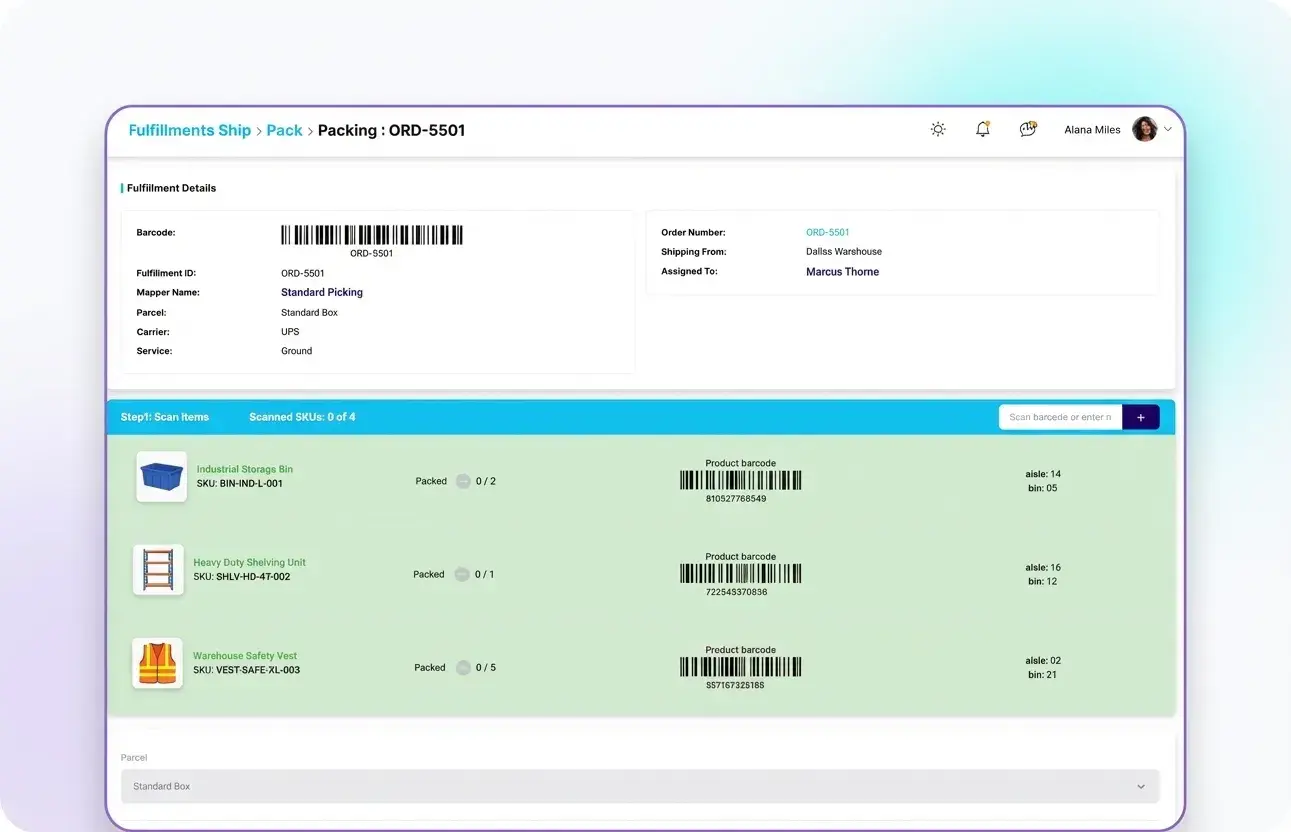
Mobile putaway screen
3

Step 3: Wave Picking — One Walk, Many Orders

Instead of picking one order at a time, SkuNexus groups orders into waves. Your picker gets a single optimized route through the warehouse, picking items for multiple orders in one pass. The system assigns items to cart slots so there's no confusion back at the packing station.
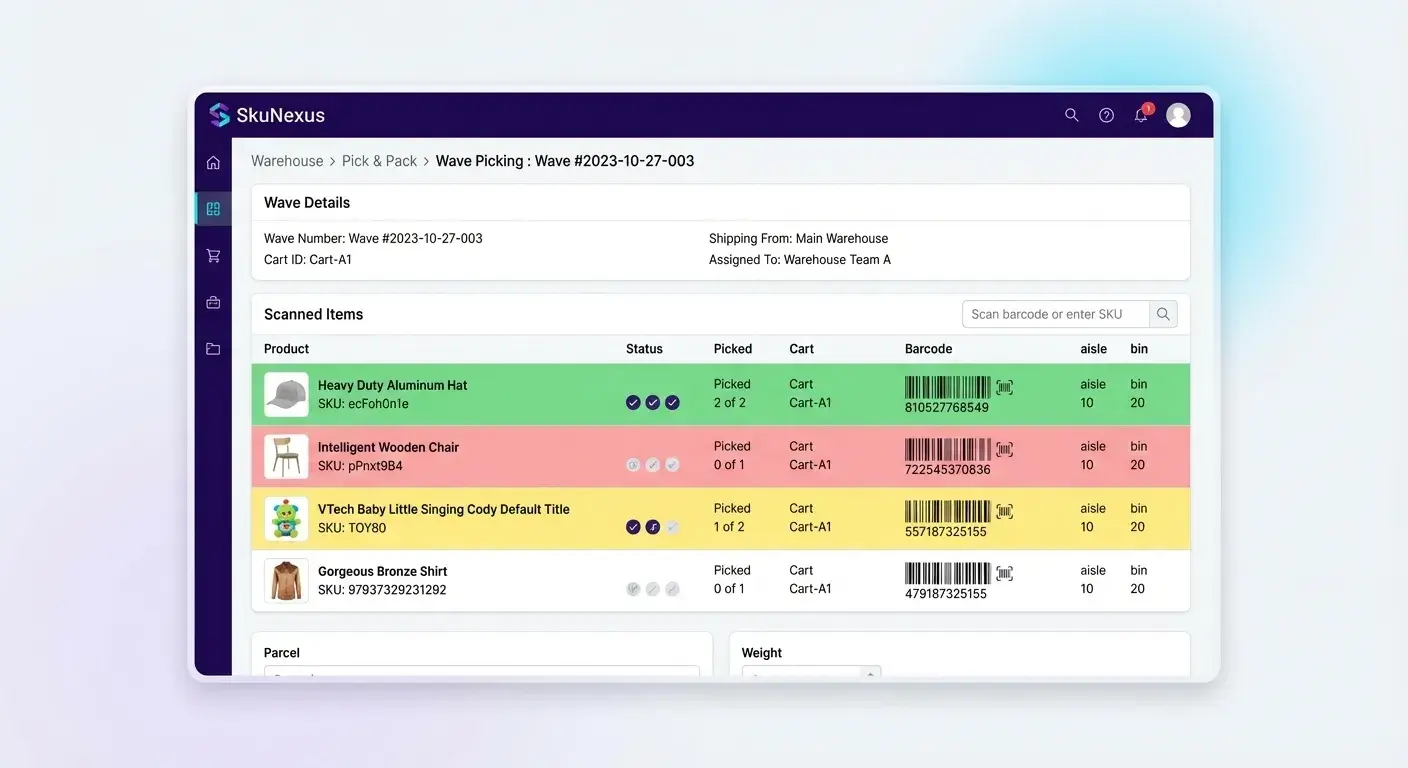
Wave picking list
4

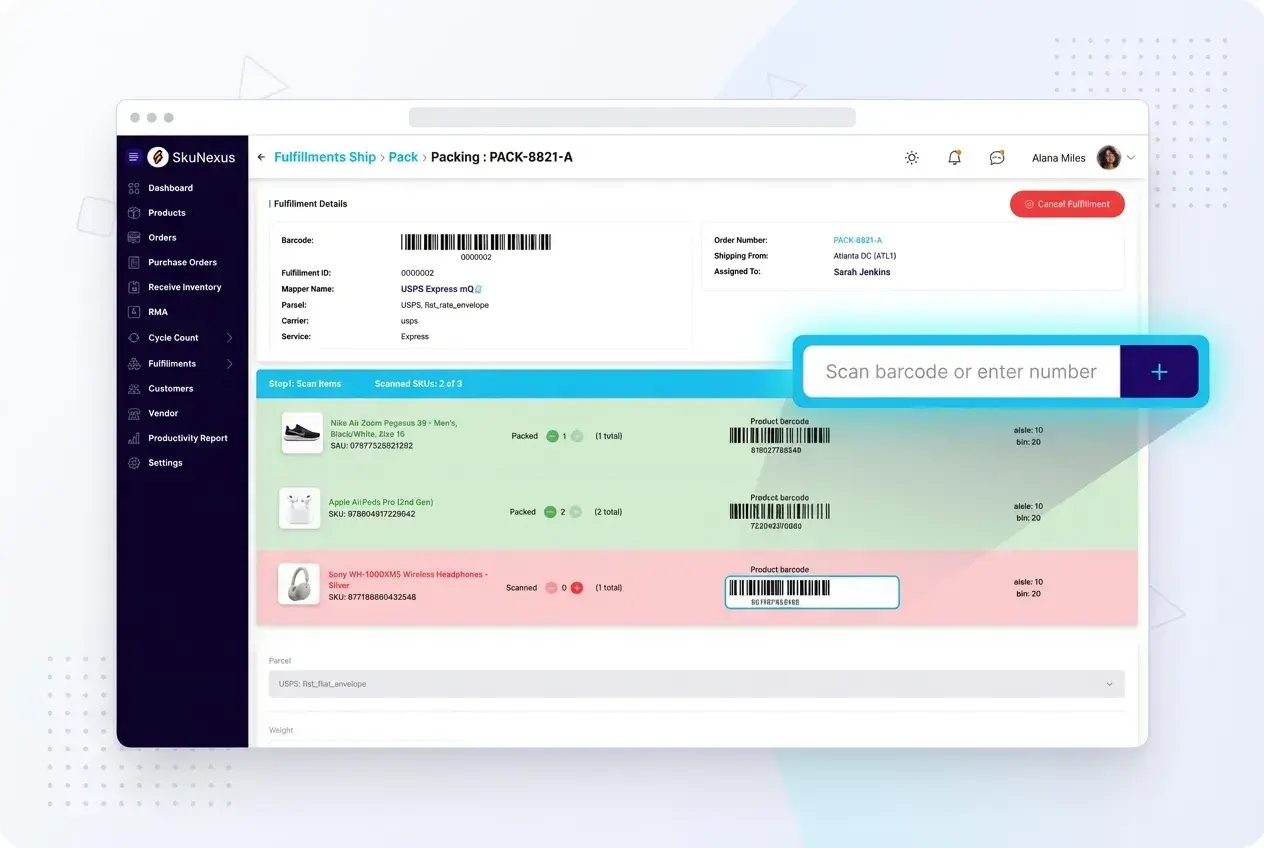
Step 4: Pack and Verify at the Station

After picking, the packer scans the cart at the packing station. Each tote is verified against the order: scan the item, confirm the quantity, select the parcel size, and the system generates the shipping label. This double-verification drives accuracy above 99.9%.
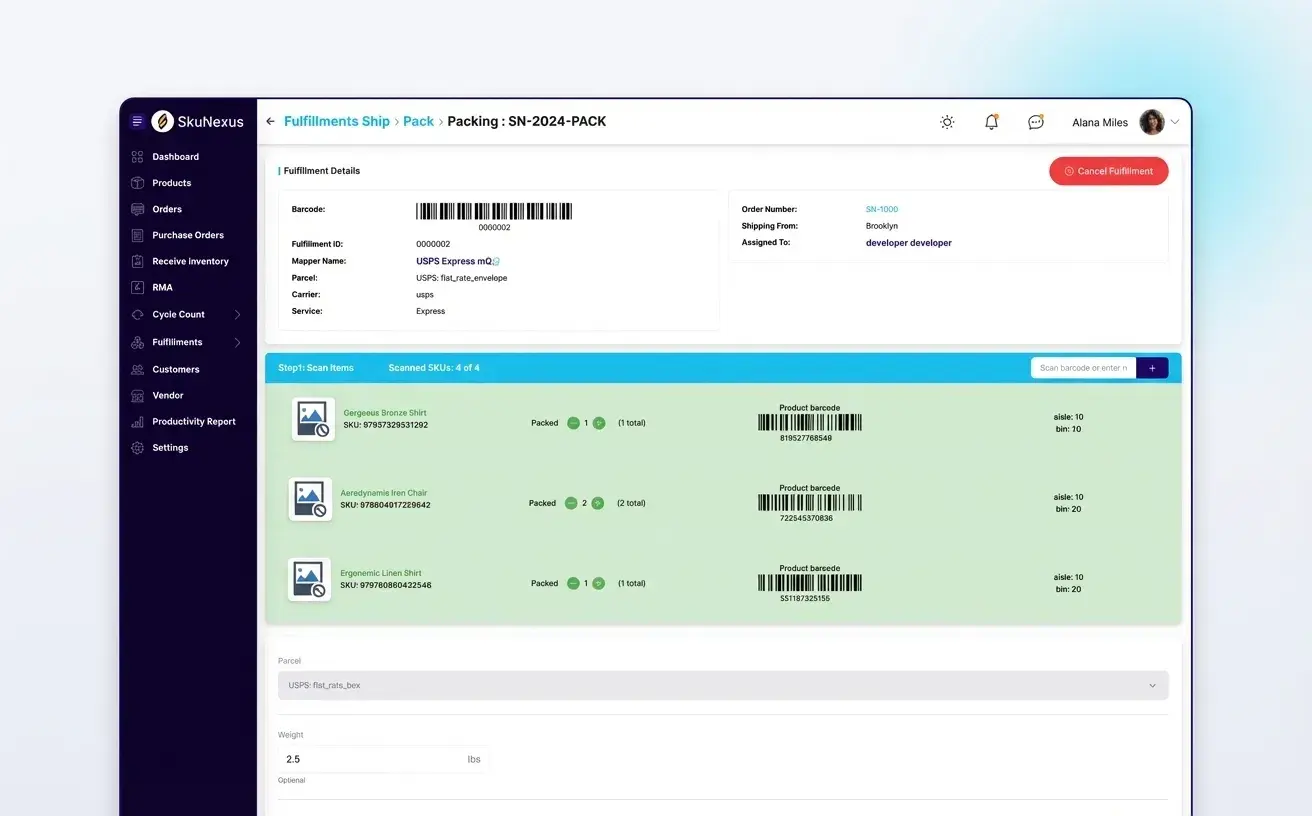
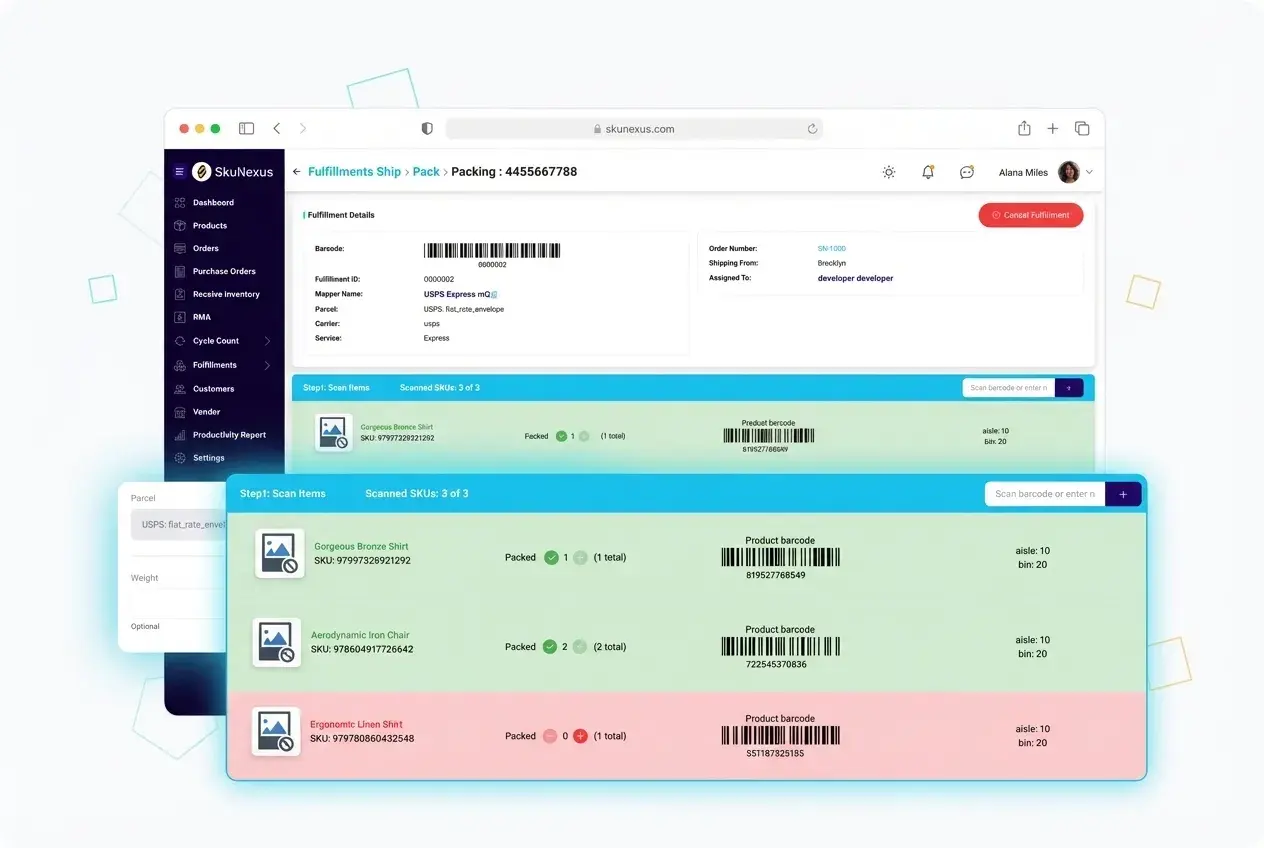
Pack station verification
Key Benefits

Why Teams Choose SkuNexus

📦

Streamlined Receiving

Scan, inspect, and process inbound shipments quickly. Inventory is available to sell the moment it's received.

📍

Smart Putaway

Direct workers to optimal storage locations based on velocity, size, or custom rules. Every item goes where it belongs.

🔄

Cycle Counting

Maintain inventory accuracy with scheduled cycle counts. Catch discrepancies before they become problems.

Warehouse Management feature 1 — SkuNexus
↓40% Receiving time
Feature

Receiving and Inspection Workflows

Process inbound shipments quickly and accurately with guided receiving workflows.
When inventory arrives, SkuNexus guides your team through the entire receiving process. Scan items against purchase orders, flag discrepancies, inspect for damage, and record everything. Inventory becomes available the moment receiving is complete. No more shipments sitting on the dock for days. No more mystery boxes in the corner.
  • Scan-based receiving against POs or ASNs
  • Discrepancy flagging for shorts, overages, and damages
  • Quality inspection checkpoints
  • Automatic inventory availability upon completion
  • Full receiving history and audit trail
See Receiving Demo
Warehouse Management feature 2 — SkuNexus
99.8% Location accuracy
Feature

Intelligent Putaway Rules

Direct workers to the optimal storage location for every item, every time.
SkuNexus tells your team exactly where to put incoming inventory based on rules you define. Fast movers go to prime pick locations. Heavy items stay low. Similar products group together. The system considers velocity, size, product type, and available space to recommend the best location. Workers follow directions instead of making decisions.
  • Rules-based putaway recommendations
  • Velocity-based slotting for fast movers
  • Size and weight considerations
  • Zone restrictions and preferences
  • Scan confirmation at destination
See Putaway Demo
Warehouse Management feature 3 — SkuNexus
↓50% Search time
Feature

Zone and Bin Location Management

Organize your warehouse with a flexible location hierarchy that matches how you actually work.
Define your warehouse structure in SkuNexus: zones, aisles, racks, shelves, and bins. Every item gets a specific home. Workers are directed to exact locations. The system tracks what's where and flags items that aren't in their designated spots. Move inventory between locations with full traceability.
  • Flexible location hierarchy (zone, aisle, rack, shelf, bin)
  • Visual warehouse mapping
  • Location capacity tracking
  • Inter-location transfers with audit trail
  • Misplaced item alerts
See Zone Management Demo
The SkuNexus Difference

Why Merchants Choose SkuNexus

🛡

Your Own Database, Your Own Data

With SkuNexus, you get a dedicated single-tenant architecture. Your data lives in its own isolated database — never co-mingled with other merchants. That means faster queries, tighter security, and zero risk of a noisy-neighbor outage taking you offline during peak season.

SkuVault can only be connected to one Shopify store through one SkuVault account.

Jeff Cayley KETL Mountain / Worldwide Cyclery — SkuNexus connects to unlimited stores from one instance.

Real-Time, Not "Close Enough"

SkuNexus syncs inventory via real-time API webhooks — not batch jobs that run every 15 minutes. When an order ships, when stock is received, when a transfer completes, every channel reflects the truth within seconds. No oversells, no phantom stock, no "we'll update overnight" excuses.

🧩

Built for Complexity, Not Just Simplicity

Most inventory systems handle the simple cases fine. SkuNexus is engineered for the edge cases that actually cost you money: kitting and bundling with shared components, multi-warehouse allocation with intelligent routing, custom fulfillment workflows that match how your operation actually works — not how a SaaS vendor thinks it should.

We looked at dozens of platforms. SkuNexus was the only one that could handle our kitting complexity without forcing us to change our process.

Operations Director Multi-brand eCommerce retailer
Case Study

A 150-year-old premium ice cream brand selling DTC, wholesale, and through national retail partners.

⚠️ The Challenge

Graeter's eCommerce operation was growing fast, but their legacy system couldn't keep up. Inventory counts were unreliable, oversells were happening weekly, and the team spent hours manually reconciling stock. During peak holiday season, the problems multiplied.

The Solution

Graeter's implemented SkuNexus to manage their eCommerce fulfillment. Real-time inventory sync eliminated oversells, automated reorder points kept best-sellers in stock, and the operations team finally had a single source of truth they could rely on.

📈 The Results

47%
Faster fulfillment
99.2%
Inventory accuracy
0
Oversells in Q4
10+
Hours saved weekly

"Our Smoothest Peak Season Ever"

A 150-year-old premium ice cream brand with a growing direct-to-consumer eCommerce operation.

Director of Operations, Graeter's Ice Cream
Live before peak season
Integrations

Works With Your Existing Hardware and Systems

Access full WMS functionality from any device with a browser. No special hardware required.

100+ Native
Integrations
+ many more
Comparison

Still Running Your Warehouse on Paper and Memory?

Paper-based processes might feel familiar, but they cost you time, accuracy, and money every single day.

Paper and Spreadsheets SkuNexus WMS
Receiving logged on paper, entered later Scan-based receiving, instant availability
Putaway wherever there's space Directed putaway to optimal locations
Items stored based on memory Every item tracked to exact bin location
Annual counts that shut down operations Continuous cycle counting
Continuous cycle counting Direct workers to exact locations
Inventory accuracy unknown 99.5%+ accuracy, always auditable

A disorganized warehouse slows everything down. Brands using SkuNexus WMS cut receiving time by 40% and virtually eliminate time spent searching for items. When your warehouse runs smoothly, everything else gets easier.

Free demo • No credit card required

FAQ

Frequently Asked Questions About Warehouse Management

A warehouse management system controls the physical movement of goods inside a warehouse - receiving, putaway, picking, packing, and shipping - with scan-verified workflows at every step. Unlike basic inventory tracking that tells you what you have, a WMS tells your team exactly where to put incoming products, creates optimized pick paths through the warehouse, and verifies every item before it ships.

The core value of a WMS is replacing tribal knowledge with system-directed workflows. Without one, your fastest picker knows where everything is because they've worked there for three years - but new hires take weeks to ramp up and make more errors. With a WMS, the system guides every worker step by step: go to this bin, scan this product, place it in this tote. Training goes from weeks to days. SkuNexus WMS uses the same scan-cart-location-product pattern for every workflow, so the muscle memory is identical whether you're picking, packing, receiving, or counting.

Wave picking groups multiple orders into a single warehouse walk. Instead of picking one order at a time - walking the same aisle six times for six separate orders - your picker grabs a cart with mapped totes and collects items for 10, 20, or 50 orders in one optimized trip. Each tote maps to an order. When the wave is complete, the totes move to packing pre-sorted and ready to ship.

The labor impact is dramatic. A warehouse operator running 800 orders per month was spending an hour a day picking one order at a time. With wave picking, that same volume takes 20 minutes. For larger operations doing 300+ orders per day, wave picking can eliminate one or more full-time warehouse positions. One prospect saw the wave picking demo and joked about reducing headcount - but the math was real. SkuNexus generates optimized wave picks based on order priority, shipping cutoff times, and warehouse geography.

Directed putaway is when the WMS tells your receiving team exactly where to place each incoming product based on rules you define. Scan the product, and the system suggests the optimal bin based on velocity-based slotting (fast movers near the shipping station), product category zones, weight and size constraints, or proximity to related products. No guessing, no "put it wherever there's space."

Without directed putaway, warehouses get slower as they grow. New inventory goes wherever someone finds room, fast-moving products end up in back corners, and your pick times creep up because nothing is where it should be. The problem compounds every time you receive a shipment. SkuNexus assigns the optimal putaway bin automatically when the product is scanned during receiving. Your team doesn't decide where things go - the system does, consistently, based on rules that optimize your warehouse layout over time.

Every warehouse action follows a three-step scan pattern: scan the container (cart or tote), scan the location (bin or staging area), scan the product (item barcode). The system verifies each scan against the expected action. Right product at the right location gets a green confirmation. Wrong match gets an immediate red alert that blocks the action before the error propagates.

This verification happens twice per order - once at pick (confirming the right item was pulled from the right bin) and again at pack (confirming every item in the box matches the order before the shipping label can print). The wrong product physically cannot ship without someone deliberately overriding the system. This double verification pushes accuracy above 99.9%. Compare that to manual picking where a 2-3% error rate means 20-30 wrong shipments per thousand orders - each one costing you a return, a reship, and a customer who may not come back.

A modern cloud-based WMS should be hardware agnostic - meaning it works on dedicated Zebra or Honeywell scanners, Android phones, iPads, consumer smartphones, or any device with a browser and a camera. This is important because it lets you start with devices your team already owns and upgrade to rugged dedicated scanners as order volume justifies the investment.

The alternative is a WMS that requires specific proprietary hardware, which means a significant upfront cost before you've even processed your first order. Some platforms only work with specific scanner models or require a native app that doesn't run on every device. SkuNexus runs entirely in a web browser, so any device that can open Chrome or Safari can scan barcodes, receive inventory, pick orders, and verify packing. Your team can use their personal phones on day one and transition to warehouse-grade hardware when it makes sense.

ShipStation generates shipping labels and offers some rate comparison. A WMS manages everything that happens before the label prints - receiving and putting away inventory, tracking bin locations, directing picks through the warehouse, verifying every item at packing, and confirming order accuracy before shipping is even possible. They solve different problems at different stages of the fulfillment workflow.

Many merchants start with ShipStation when they're small - printing orders, walking the warehouse, manually finding products, and generating labels. The breaking point usually comes when picking errors, mispicks, and wrong-item shipments start costing more in returns and customer churn than WMS software would cost. One prospect described their current process as "printing out orders, going, picking, packing" - entirely manual with no verification. SkuNexus replaces the gap between your inventory system and your shipping labels with scan-verified warehouse workflows that catch errors before packages leave the building.

Most warehouses can be fully mapped with bin locations in one to two days. You define your zone structure (bulk storage, pick-face, returns, quarantine), create the location hierarchy in the system (Zone > Aisle > Rack > Shelf > Bin), print barcode labels for each location, and stick them up. Once placed, every location becomes scannable and the WMS tracks what's stored in each bin.

The setup effort is a one-time investment that pays off immediately. Before bin locations, your team relies on memory to find products - which works until someone is out sick, quits, or you hire a new person who doesn't know where anything is. After bin locations, the system tells every worker exactly where to go regardless of experience level. SkuNexus generates the barcode labels for your entire location hierarchy, supports hierarchical structures of unlimited depth, and tracks capacity per location so putaway rules can account for available space.

Still have questions?

Talk to Our Team

Bring Order to Your Warehouse

See how SkuNexus WMS can transform your receiving, putaway, and inventory accuracy.

Free demo No commitment See your warehouse live