B2B Wholesale Fulfillment: How to Handle Bulk Orders at Scale
What B2B Wholesale Fulfillment Actually Means
Your B2C fulfillment team just got their first 500-unit wholesale order. They're about to discover why their current setup won't work.
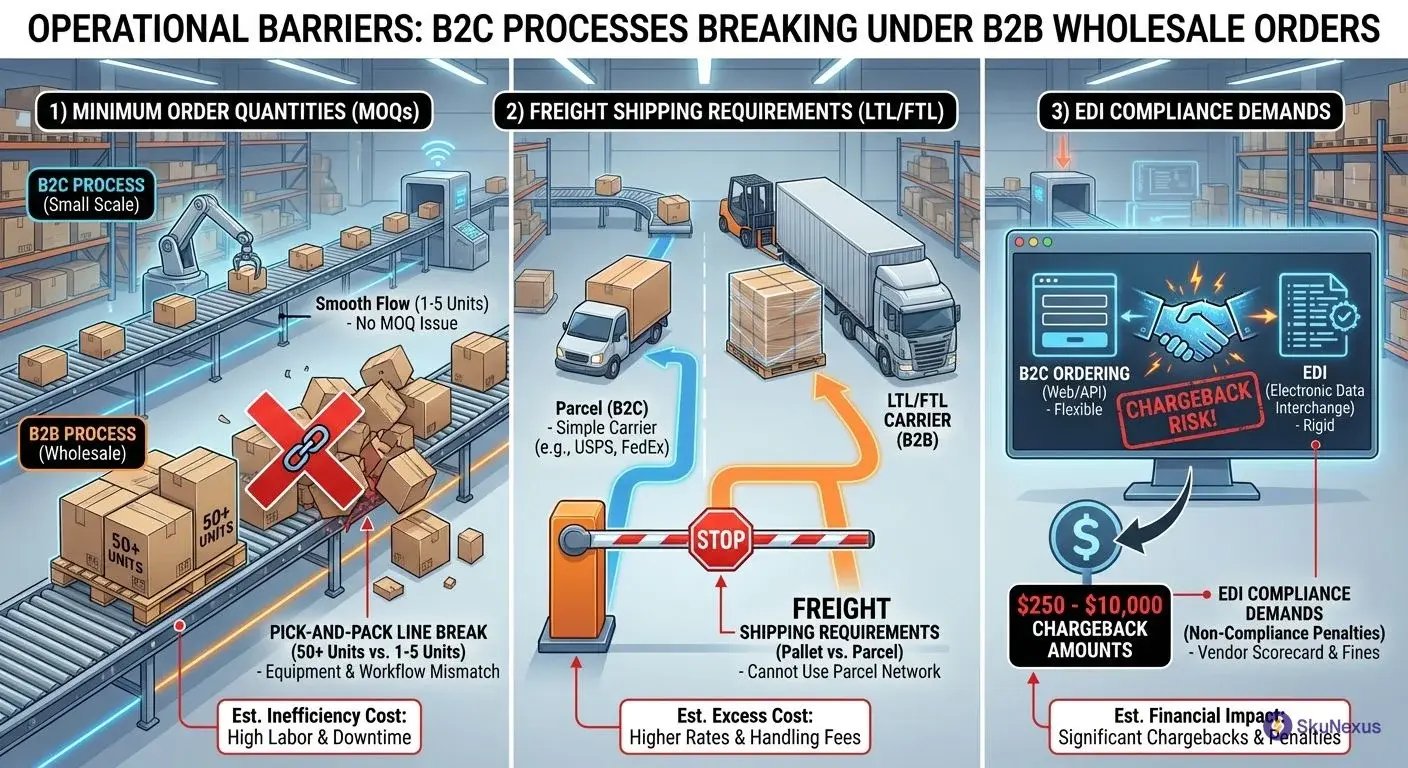
Three operational barriers will break your existing processes:
Minimum order quantities crush standard processes. Your pick-and-pack line built for 1-5 units breaks at 50+ units per order. I watched a client's team spend 3 hours picking a 200-unit order using their B2C process. They switched to batch picking the next day.
Freight shipping replaces parcels. UPS won't take a pallet. You need LTL (less-than-truckload) or FTL (full truckload) carriers. That means dock scheduling, BOLs, and freight classifications. Different game entirely.
EDI compliance isn't optional. Major retailers demand electronic data interchange for orders, invoices, and shipping notices. Miss one EDI requirement? Chargebacks start at $250 per error. Target charges $10,000 for repeated violations.
Here's what breaks when you scale up: Your WMS can't batch pick efficiently. Your staff burns out on manual processes. Your shipping dock becomes a bottleneck. Your inventory accuracy drops because you're moving larger quantities without proper controls.
Stop treating wholesale orders like bigger B2C orders. Start building processes that handle volume from day one.
B2B vs B2C: The 7 Operational Differences That Matter
B2C systems optimize for speed on small orders. B2B order fulfillment demands bulk efficiency. These seven differences force complete process overhauls:
📷 Table comparing B2B and B2C fulfillment metrics
| Metric | B2C | B2B |
|---|---|---|
| Order Size | 1-5 units | 50-5,000 units |
| Shipping Method | Parcel (UPS, FedEx) | Freight (LTL/FTL) |
| Order Frequency | Daily | Weekly/Monthly |
| Documentation | Packing slip | BOL + compliance docs |
| Returns Rate | 15-30% | 2-5% |
| Payment Terms | Immediate | NET 30/60 |
| Packaging | Branded individual | Bulk/pallet |
Order size alone breaks most operations. Pick stations built for 5-item orders can't handle 500-unit picks without major workflow redesigns. Your warehouse layout needs wider aisles for forklifts. Pick paths must accommodate bulk containers instead of totes.
Payment terms shift from immediate to NET 30/60. Returns drop from 30% to under 5%. Documentation explodes from simple packing slips to bills of lading plus compliance paperwork.
Freight Shipping: Your New Reality
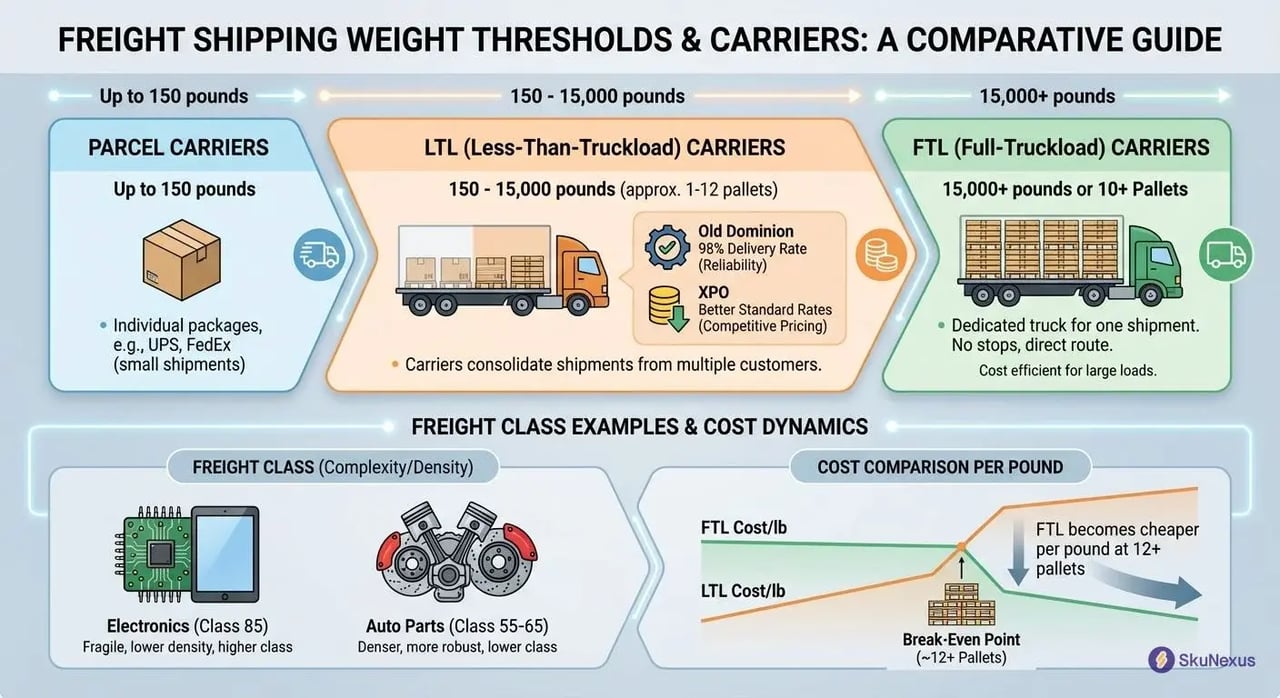
At 150+ pounds, parcel carriers stop. LTL handles 150-15,000 pounds. Old Dominion hits delivery windows 98% of the time. XPO offers better rates on standard deliveries.
FTL kicks in at 15,000+ pounds or 10+ pallets. The math flips—FTL costs less per pound once you hit 12 pallets.
Know your freight classes. Electronics ship Class 85. Auto parts hit Class 55-65. Wrong classification triggers reclassification and back-billing. I've seen $500 shipments become $1,200 nightmares.
Compliance Labels: GS1-128 Requirements
GS1-128 labels replace shipping labels. Four zones required:
- Zone A: Addresses
- Zone B: Carrier routing barcode
- Zone C: PO number, department, store number
- Zone D: SSCC-18 serial container code
Target demands labels within 1/8" placement tolerance. Home Depot requires 1.25" minimum barcode heights. One mislabeled pallet triggers thousands in fines.
How B2B Order Fulfillment Works: The 6-Step Process
Here's what happens from PO to delivery.
📷 Flowchart showing 6 steps of B2B wholesale fulfillment
B2B order fulfillment moves through six stages:
1. Receiving (2-4 hours for 500 cases)
Unload, count, scan barcodes, update inventory. Two-person team handles 500 cases in 2-4 hours.
2. Putaway (1 hour)
Move product to storage locations. Scan location barcodes to prevent lost inventory. One hour covers 10 pallets.
3. Order Processing (15 minutes EDI validation)
EDI 850 purchase order validates against inventory, pricing, shipping requirements. Good systems flag issues in 15 minutes.
4. Picking (2 hours for 10-pallet order)
Generate pick lists sorted by warehouse zone. Ten pallets take 2 hours with proper slotting.
5. Packing/Palletizing (45 minutes)
Stack cases on 48x40" GMA pallets per retailer specs. 48" max height, no overhang. Takes 45 minutes for experienced teams.
6. Freight Scheduling (30 minutes plus 24-48 hour lead time)
Book carrier, print BOLs, schedule pickup. Carriers need 24-48 hours advance notice for LTL.
Total time: 6-8 hours labor plus 24-48 hours lead time. Wholesale fulfillment requires different planning than parcel shipping.
Wholesale Order Management: From EDI to Pick List
Wholesale order management starts with EDI 850 validation. Your system checks inventory accuracy (need 98%+), then available-to-promise stock.
Common EDI failures:
- Invalid product codes (3% of orders)
- Pricing mismatches (5% of orders)
- Quantity exceeds stock (8% of orders)
Keep EDI errors under 2%. Each manual fix costs $15-25 in labor.
Pick lists sort by warehouse zone. Heavy items first, fragile last. Scan verification and weight checks catch quantity errors—10 cases should weigh 120 pounds, not 96.
Bulk Picking Strategies That Actually Work
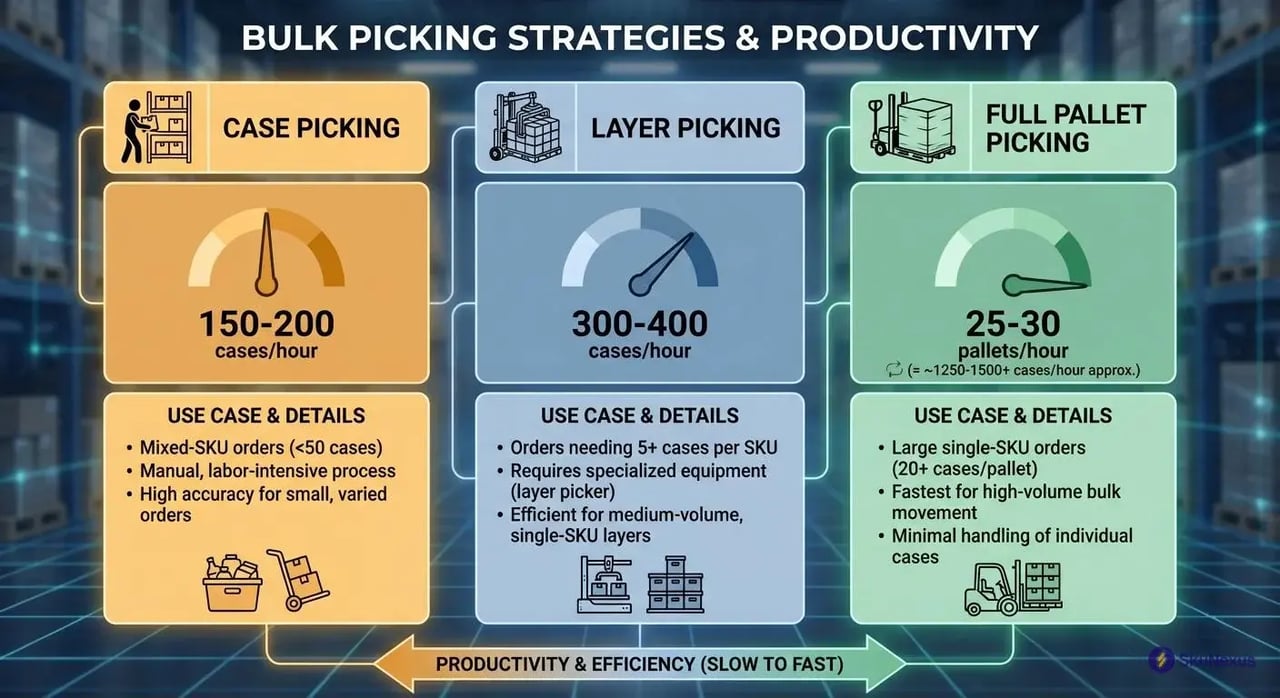
Match your strategy to order profiles:
Case Picking: 150-200 cases/hour
Individual case selection for mixed-SKU orders under 50 cases.
Layer Picking: 300-400 cases/hour
Pull entire layers using specialized equipment. Works when orders need 5+ cases per SKU.
Full Pallet Picking: 25-30 pallets/hour
Move entire pallets from storage to shipping. Only for large single-SKU orders of 20+ cases.
Returns Processing at 2% vs 20%
B2B returns run 2-5% versus B2C's 15-30%. Business buyers know what they're ordering.
The RMA process:
- Customer calls—issue RMA number immediately
- Schedule freight pickup
- Inspect within 48 hours of receipt
- Process credit within 5 business days
Inspection criteria:
- Unopened cases: Full credit
- Opened but resellable: 85% credit
- Damaged packaging: 75% credit
- Product damage: No credit (file carrier claim)
Document everything with photos. Business customers have tight cash flows—delayed credits strain relationships.
Technology Stack for Wholesale Order Management
You need 4 systems minimum. Manual wholesale order management breaks at 500 orders per month.
WMS (Warehouse Management System)
Manhattan Associates handles complex routing. Blue Yonder scales for high volume. Integration: 3-6 months. Cost: $3,000-5,000 monthly.
EDI Platform
SPS Commerce owns 60% of retail EDI. TrueCommerce costs less but needs more setup. Both handle core documents (850, 855, 856). Setup: 2-4 weeks. Cost: $2,000-4,000 monthly.
TMS (Transportation Management System)
MercuryGate optimizes multi-modal shipping across LTL, parcel, and truckload. 3Gtms integrates cleaner with WMS platforms through native APIs. Either system reduces freight costs 15-20% through automated route optimization. Implementation: 6-8 weeks. Cost: $1,500-3,500 monthly.
Inventory Visibility Tool
Real-time ATP prevents overselling on large orders. We run this through SkuNexus—catches allocation conflicts before they hit the warehouse. Generic tools miss B2B order fulfillment nuances. Setup: 2-3 weeks. Cost: $1,000-2,500 monthly.
📷 Diagram showing WMS, EDI, TMS, and inventory systems integration
Total monthly investment: $7,500-15,000. One major EDI chargeback costs $10,000.
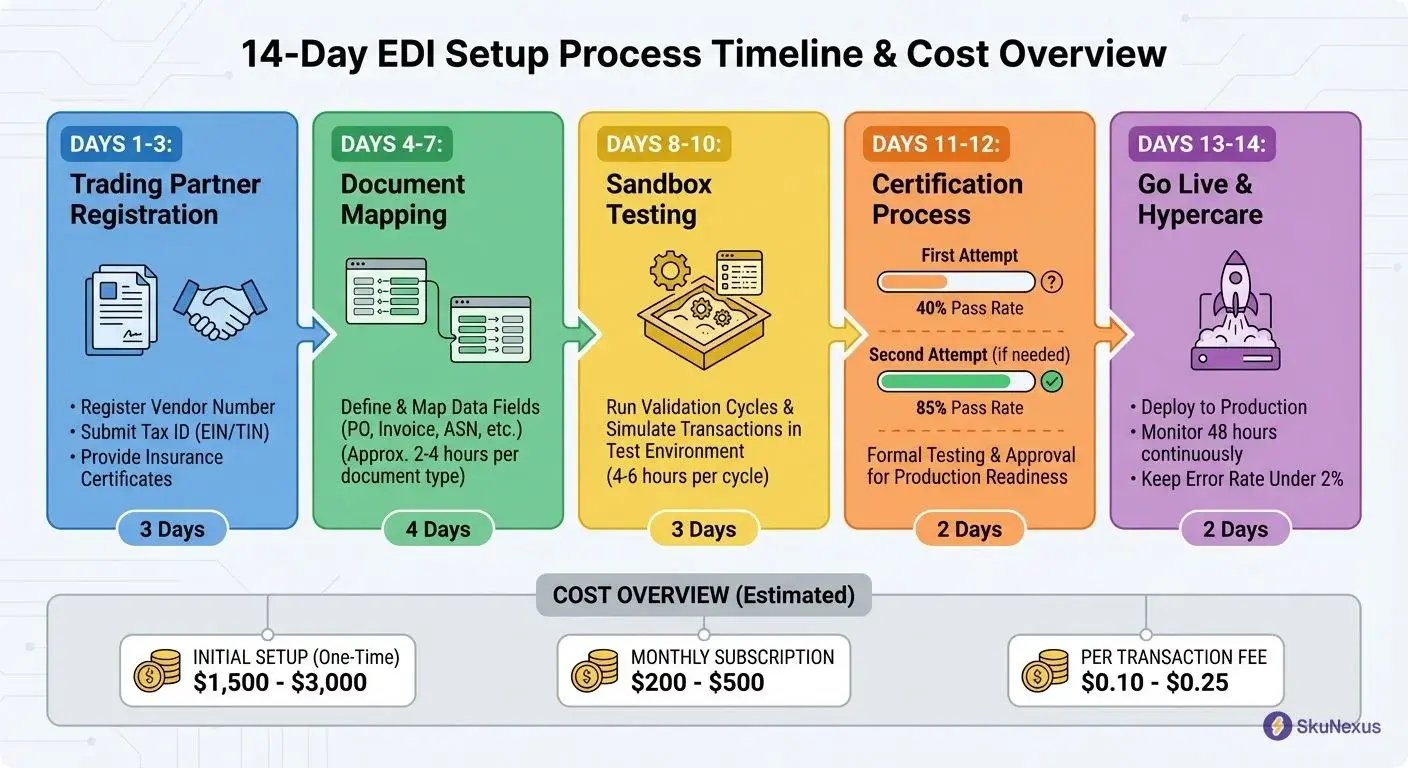
EDI Setup: 14 Days to First Transaction
Day 1-3: Trading Partner Registration
Submit paperwork to retail partners. Target needs vendor number, tax ID, insurance certificates. Walmart adds SQEP compliance.
Day 4-7: Document Mapping
Map your data fields to retailer specs. Home Depot's "Department Number" doesn't match anyone else's format. Each mapping takes 2-4 hours.
Day 8-10: Sandbox Testing
Send test transactions. Expect failures on date formats, missing qualifiers, segment terminators. Each test cycle: 4-6 hours including fixes.
Day 11-12: Certification
Live testing with real document flow. First attempt pass rate: 40%. Second attempt: 85%.
Day 13-14: Go Live
Monitor every transaction for 48 hours. Keep error rates under 2%.
Setup costs: $1,500-3,000. Monthly: $200-500 base plus $0.10-0.25 per transaction. A 1,000-order operation eliminates $15-25 per order in manual processing.
When to Outsource B2B Wholesale Fulfillment
Six triggers tell you when to outsource b2b wholesale fulfillment:
Shipping 500+ orders monthly - Your team drowns in pick lists. Order accuracy drops below 98%. You need 3-4 warehouse staff at $12,000 monthly before benefits.
Needing 10,000+ square feet - Rent hits $6,000-8,000 monthly. Add utilities and insurance. You're spending $10,000+ before touching orders. Plus $100,000 in equipment.
Freight spend exceeding $50,000 monthly - 3PLs secure 15-25% better rates through volume. That's $7,500-12,500 saved monthly on your current spend.
EDI requirements from 3+ retailers - Each retailer has unique specs. Miss one requirement? Chargebacks start at $250 per error. 3PLs handle hundreds of retailer connections daily.
Geographic expansion beyond 500 miles - Shipping costs double. Multiple distribution centers cut freight 40%, but running them yourself multiplies complexity faster than savings.
Seasonal spikes over 200% - Holiday volume triples orders. Training temporary staff takes two weeks. By then, peak season's half over.
These are breaking points where economics flip.
Real Cost Analysis: In-House vs 3PL
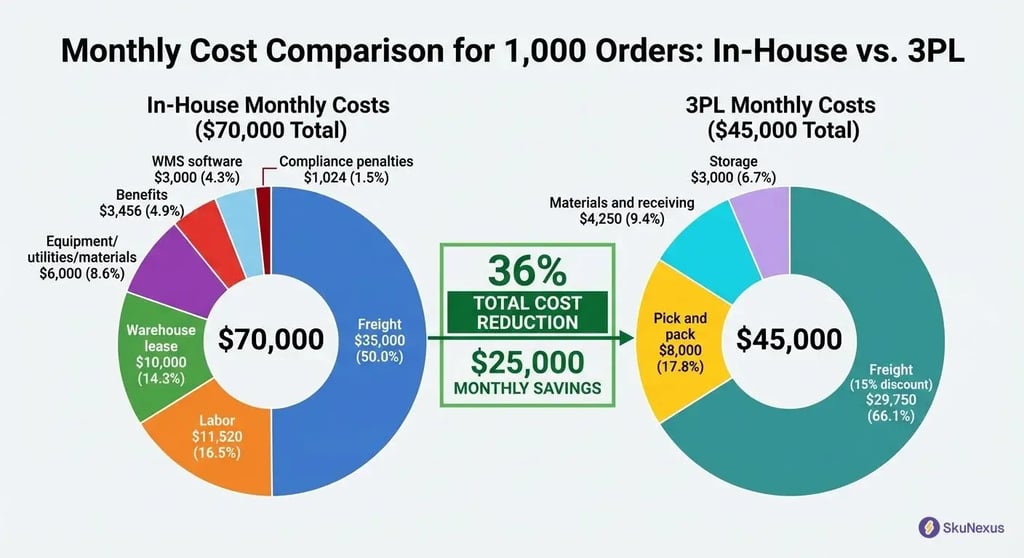
The math for 1,000 orders monthly:
In-House Costs:
- Warehouse lease (15,000 sq ft): $10,000/month
- Labor (4 FTEs): $11,520/month
- Benefits (30%): $3,456/month
- WMS software: $3,000/month
- Freight: $35,000/month
- Equipment, utilities, materials: $6,000/month
- Compliance penalties: $1,024/month
Total: $70,000/month
3PL Costs:
- Pick and pack: $8,000/month
- Storage: $3,000/month
- Freight (15% discount): $29,750/month
- Materials and receiving: $4,250/month
Total: $45,000/month
That's $25,000 monthly savings—36% reduction. 3PLs spread fixed costs across dozens of clients. You pay only for what you use.
Choosing a B2B Fulfillment Partner: The 10-Point Checklist
Score every potential b2b fulfillment partner on these 10 criteria. Anything below 40/50 total? Keep looking.
📷 Checklist for evaluating B2B wholesale fulfillment providers
1. Freight Carrier Relationships (Score 1-5)
Count their carrier contracts. 10+ LTL carriers = 5 points. 5-9 carriers = 3 points. Under 5 = 1 point. More carriers mean better rates and backup options when capacity tightens. Ask for their rate cards—good partners share them openly.
2. EDI Capability with YOUR Retailers (Score 1-5)
Generic EDI means nothing. They need live connections with your specific retailers. Already connected to Target, Walmart, and Home Depot? 5 points. Can connect within 14 days? 3 points. "We'll figure it out"? 1 point.
3. Inventory Accuracy Verification (Score 1-5)
Request their last 90 days of cycle count reports broken down by SKU category. Look for variance percentages, adjustment frequencies, and root cause analysis. Full transparency with detailed reporting = 5 points. Summary reports only = 3 points. Refuses to share data = 1 point. Demand actual cycle count worksheets, not just summary percentages.
4. OTIF Performance 98%+ (Score 1-5)
On-Time-In-Full rates below 98% trigger retailer penalties. 98%+ = 5 points. 95-97% = 3 points. Below 95% = 1 point. Get performance data by retailer—some 3PLs excel with Walmart but struggle with Target.
5. Same-Day Order Processing (Score 1-5)
Orders received by 2 PM ship today? 5 points. Next-day processing? 3 points. 48+ hours? 1 point. Wholesale fulfillment speed matters when retailers run tight inventory.
6. Custom Packaging Capability (Score 1-5)
Full custom pack lines with print-on-demand labels? 5 points. Basic customization (inserts, stickers)? 3 points. Standard packaging only? 1 point. Retailers increasingly demand specific packaging—flexibility here prevents future headaches.
7. Returns Processing (Score 1-5)
Dedicated returns team with 48-hour inspection SLA? 5 points. 3-5 day processing? 3 points. "Returns go in the queue"? 1 point. Fast returns processing builds trust with your retail partners.
8. Scalability - 3X Volume Capacity (Score 1-5)
Can they handle your peak season without blinking? Proven 3X surge capacity = 5 points. 2X capacity = 3 points. Already near limits = 1 point. Ask about their November-December performance last year.
9. Geographic Coverage (Score 1-5)
Multiple DCs within 500 miles of your retailers? 5 points. Single strategic location? 3 points. Wrong coast entirely? 1 point. Location drives freight costs—bad placement adds 20-30% to every shipment.
10. Integration Timeline Under 30 Days (Score 1-5)
Full integration in 30 days? 5 points. 31-60 days? 3 points. 90+ days? 1 point. Every week of delay costs money. We've seen "8-week integrations" stretch to 6 months.
Scoring guide:
- 45-50: Excellent partner, negotiate hard on pricing
- 40-44: Good fit, address the gaps
- 35-39: Proceed cautiously, major gaps exist
- Below 35: Wrong partner, keep searching
The best b2b wholesale fulfillment partners score 45+. They've invested in the infrastructure, technology, and processes that wholesale demands. Don't compromise below 40—the hidden costs eat any savings.
Red Flags That Mean Walk Away
Five dealbreakers kill partnerships before they start. See any of these? Run.
No existing EDI connections with your retailers
"We'll build them" means 3-6 months of manual order processing. Each manual order costs $15-25 in labor. For 1,000 monthly orders, that's $15,000-25,000 in hidden costs. Plus inevitable errors triggering chargebacks.
Won't share detailed inventory reporting
Demand weekly cycle count reports with SKU-level variance data. Ask for their adjustment log from the last quarter. No access to raw data means they're hiding problems. One client discovered their "accurate" 3PL was making 200+ daily adjustments—all invisible in summary reports.
No real-time visibility
"We'll send daily reports" isn't visibility. You need real-time ATP checks, live inventory levels, order status updates. Without this, you're flying blind. One client learned about stockouts from angry retailer calls—3 days after the 3PL knew.
Minimum volume requirements above your 6-month forecast
They want 5,000 orders monthly, you're doing 2,000? The math breaks. You'll pay for unused capacity or face penalties. Find partners who match your actual volume, not your aspirational targets.
Setup fees exceeding $10K
Standard setup runs $2,500-5,000. Above $10K means either massive customization (red flag) or they're front-loading profits (bigger red flag). One prospect quoted us $35,000 setup. We found an equivalent partner for $4,000.
Each dealbreaker compounds. Bad inventory practices plus no visibility? You're hemorrhaging money daily. High minimums plus huge setup fees? They're locking you into a bad deal. Walk away. Better partners exist.
Industry-Specific Requirements You Can't Ignore
Generic 3PLs fail here. Your industry has non-negotiable requirements that shut down operations when missed.
Healthcare demands DSCSA compliance. Serialize every case. Maintain transaction history for 6 years. Miss one serial number? FDA investigations follow.
Food operations require strict FIFO rotation. Physical barriers separate allergens. Cross-contamination means permanent shutdown.
Automotive runs on 2-hour delivery windows. Miss your Ford plant slot? The line stops at $10,000 per minute in downtime charges.
These daily requirements separate specialized wholesale fulfillment from generic warehousing. One compliance failure costs $100K+ in rejected orders.
Healthcare Compliance: Beyond Temperature Control
DSCSA compliance determines your survival in healthcare distribution.
Serialize at case level. Inline scanners capture 2D barcodes at 300+ cases per hour. Manual entry breaks at 50 cases. Your WMS stores GTIN, serial number, lot number, and expiration date for every case.
T3 documentation has a 48-hour deadline. CVS requests transaction history? You have exactly 48 hours to produce complete Transaction Information, Transaction History, and Transaction Statement records. Miss the deadline, lose the partnership.
Temperature mapping requires nine monitoring points. Four corners at floor level, four at top shelf, one center point. Each logs every 15 minutes. Document any excursion beyond 2-8°C lasting more than 30 minutes with affected lot numbers and disposition decisions.
Optimizing Your Current B2B Operations
Not ready to outsource? Here are 3 changes that deliver ROI within 30 days.
Wave Picking (40% Throughput Increase)
Stop picking orders one at a time. Group 10-20 orders by warehouse zone. Walk the warehouse once instead of 20 times. We jumped from 150 to 210 orders per day.
Implementation: 5 days. Day 1: analyze order patterns. Day 2: reconfigure WMS. Day 3: train pickers. Days 4-5: run parallel systems.
Cost: $2,000 (staging tables, training time). ROI: $7,200 monthly in avoided labor costs.
Zone Skipping with LTL Carriers (15-20% Freight Savings)
Call your top 3 carriers. Say: "We ship X pallets monthly to these zip codes. What zone skipping options reduce costs?" Old Dominion offers it on 500+ mile lanes. XPO requires 750+ miles.
Implementation: 14 days for carrier negotiations and routing guide updates. No capital investment.
We moved 200 monthly shipments to zone skipping. Average savings: $32 per shipment. That's $76,800 annually.
Automate EDI Error Handling (75% Less Manual Intervention)
Build automated rules: Invalid product codes check alternate SKU tables. Quantity overages auto-split shipments. Price variances under 3% auto-accept.
Implementation: 10 days. Cost: $2,000 in developer time. Manual EDI fixes cost $20 per error. At 10 daily errors, automation saves $3,000 monthly.
Total investment: $5,000. Monthly savings: $16,600. Start with wave picking—it's the fastest win for b2b order fulfillment.
KPIs That Actually Matter
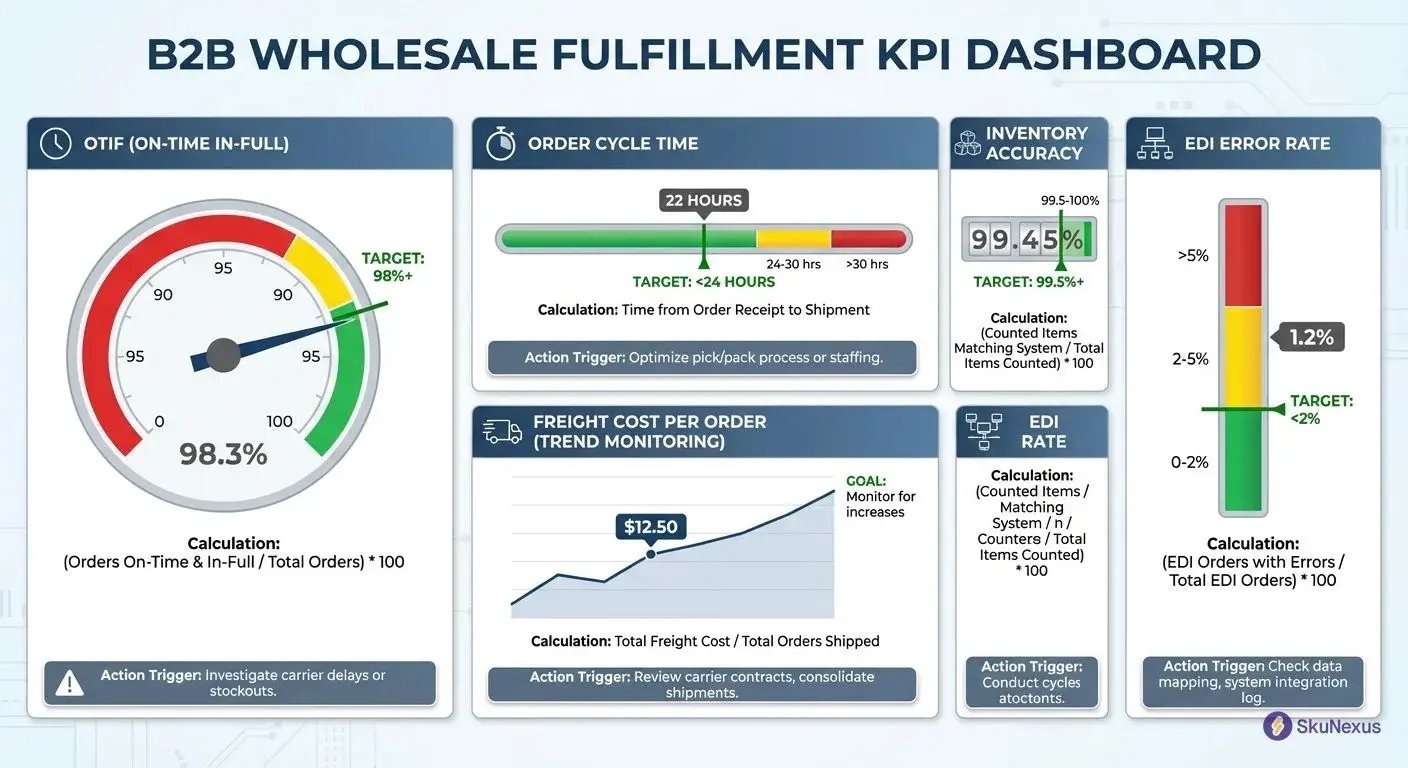
Track these 5 metrics weekly:
OTIF (Target: 98%+): (Orders delivered complete and on time) ÷ (Total orders) × 100. Below target? Check picking accuracy first.
Order Cycle Time (Target: Under 24 Hours): Time from order receipt to ship confirmation. Over 24 hours? Move cutoff time later or add second wave.
Inventory Accuracy (Target: 99.5%+): (Correct counts) ÷ (Total SKUs counted) × 100. Below target? Institute cycle counts during picking.
Freight Cost Per Order: Total freight spend ÷ orders shipped. Watch trends. 10% spike means investigate immediately.
EDI Error Rate (Target: Under 2%): (Manual fixes) ÷ (Total transactions) × 100. Above 2%? Each fix costs $15-25.
Pick one metric. Track it for 7 days. Your next move becomes obvious.
Ready to Transform Your Operations?
See how SkuNexus gives you full control over inventory, orders, warehouse, and shipping.
Schedule a Free Demo →
Keep Reading