How to Implement Shipping Rate Shopping That Actually Reduces Costs
From dry-ice shipping rules to zero-inventory dropship, SkuNexus runs fulfillment the way your operation actually works, because the workflows are built around you rather than the other way around.
Carrier rate decisions are where that promise gets tested. In SkuNexus buying conversations, merchants describe live-rate setups that misfire at checkout with "inconsistent shipping rate quotes" and "inconsistent errors that pop up out of nowhere," and shipping stacks where the person printing labels is also the one deciding, order by order, which carrier gets the package. Rate shopping only reduces costs when the comparison runs automatically inside your fulfillment workflow, on every shipment, under rules you set once. This guide covers how to implement it that way.
Buying Rate Shopping Software: The Short Answer
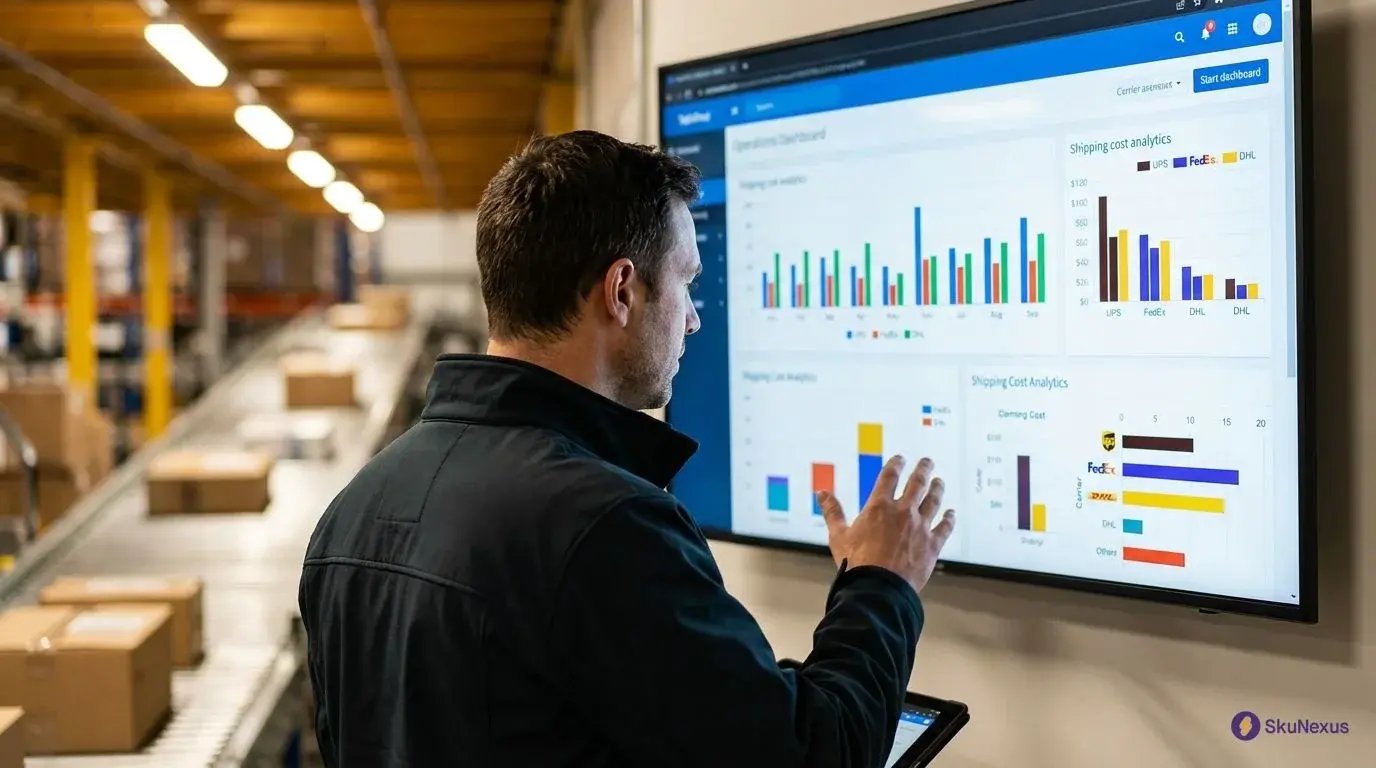
Rate shopping software compares live carrier rates and service levels for each shipment, picks the option that satisfies your rules, and hands the label off to fulfillment. If you are shopping for it, the open question is rarely whether comparison saves money. It is whether the comparison runs automatically on every shipment inside the system that already prints your labels, or stays a manual lookup somebody performs when there is time.
SkuNexus runs rate shopping inside the fulfillment workflow rather than as a separate tool, so a rule you set once is applied to every order without a person in the loop.
What to Evaluate Before You Buy
- Where the decision happens. Rate selection belongs in the order workflow, not in a separate portal a packer has to remember to open.
- Rules beyond cheapest. Delivery promise, service level, package characteristics, and customer tier all need to be expressible, not just lowest cost.
- Your own negotiated rates. Confirm the system reads your carrier accounts and contract rates rather than published retail rates.
- Failure behavior. Ask what ships when a carrier API times out, and whether a fallback carrier rule can be defined in advance.
- Auditability. You should be able to answer later why a specific shipment went out on a specific carrier.
Want to see rate shopping run on your own carrier mix? Book a live SkuNexus demo.
The Three Levels of Rate Shopping Maturity
Shipping rate shopping - the automated process of comparing carrier rates and service options across multiple providers for each shipment - has become table stakes for modern logistics. Yet most companies think they're optimizing shipping because they negotiated decent carrier contracts, operating at Level 1 maturity and leaving massive savings untapped.
Level 1: Basic Cost Comparison (5-8% savings)
73% of companies stall here. They compare published rates across 2-3 carriers, selecting the cheapest option. These organizations treat each shipment as an isolated transaction, achieving modest 5-8% cost reduction.
Level 2: Time-in-Transit Optimization (12-15% savings)
Level 2 companies balance cost against delivery speed. They analyze when paying more for next-day delivery prevents a customer service call. The math shifts from "cheapest rate" to "optimal value," delivering 12-15% savings while improving delivery performance.
Level 3: Advanced Date Shopping (20%+ savings)
The elite 5% operate here. They incorporate weather patterns, carrier performance data, and predictive analytics into routing decisions. These systems factor Thursday's storm forecast when routing Tuesday's shipments and balance carrier volumes to maintain negotiating power. Rate shopping shipping becomes strategic orchestration, not tactical comparison.
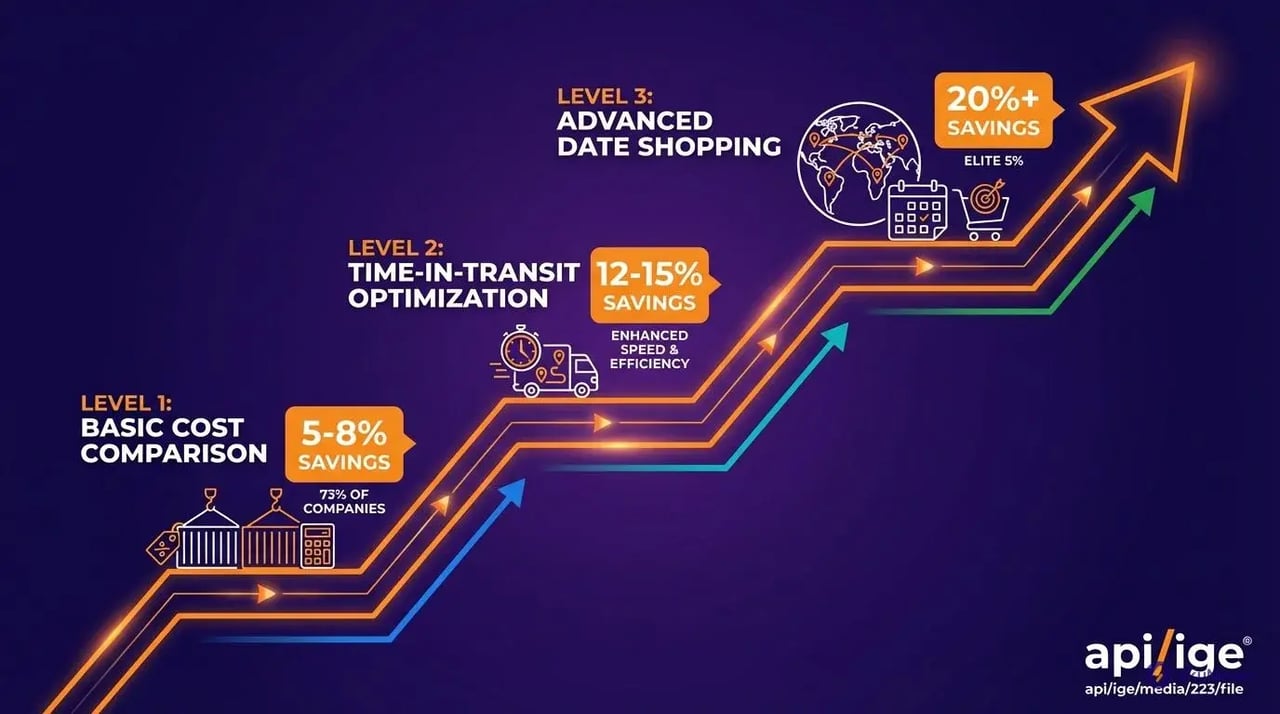
The gap between Level 2 and Level 3 explains why supply chain executives report feeling stuck despite investing in new technology. They've automated the wrong processes - optimizing individual shipments instead of orchestrating entire shipping networks across time and carrier relationships.
7 Strategic Benefits Beyond Cost Reduction
The operational transformation creates exponentially greater value through shipping cost optimization that compounds across seven measurable dimensions.
Most teams get this wrong. They focus on the immediate savings while missing the operational multiplier effects. Take order processing speed: when Warby Parker automated their carrier selection, they cut manual routing decisions from 15 minutes to 30 seconds per order. The time savings allowed their fulfillment team to process 40% more orders without additional headcount. Cart abandonment follows a similar pattern - Shopify merchants using dynamic rate shopping see 15-25% fewer customers bail at checkout when presented with real shipping options versus flat-rate guessing.
On-time delivery improvements stem from intelligent routing that reads disruption patterns. When winter storms hit the Midwest, advanced systems automatically shift volume from ground carriers to air freight before delays cascade. The result: 10-15% better delivery performance during peak disruption periods.
Customer service load drops when packages arrive predictably. Zappos reduced shipping-related support tickets by 30% after implementing real-time carrier comparison. The system routes packages through carriers with the best performance records for specific lanes. Storm approaching Memphis? FedEx packages automatically reroute through alternate hubs before the weather hits.
Volume commitments transform from constraints into strategic assets. Traditional shipping locks you into carrier minimums that force suboptimal routing. Advanced systems balance volumes dynamically, meeting commitments without overspending. A mid-sized electronics manufacturer discovered they were overspending to hit UPS minimums while USPS offered better rates on 30% of their shipments.
Disaster recovery shifts from reactive scrambling to proactive routing. During the 2021 Suez Canal blockage, companies with real-time rate shopping pivoted shipping modes within hours while competitors waited weeks for manual contract adjustments.
Compliance automation eliminates the complexity plaguing regulated industries. Healthcare shipments require temperature validation. Hazmat needs specific carrier certifications. Automated rate shopping embeds compliance rules directly into routing logic, selecting only qualified carriers for sensitive shipments.
Turn Shipping from Cost Center to Competitive Advantage
The real question isn't whether to offer shipping choices - it's how to make those choices profitable. E-commerce platforms consistently show that stores offering 3-5 shipping tiers see 12-20% higher conversion rates than single-option competitors. Express shoppers subsidize standard delivery while zone skipping creates margin. The net effect: higher revenue and 12% lower average shipping costs from the same strategic shift.
The Technical Architecture That Powers 2-Second Decisions
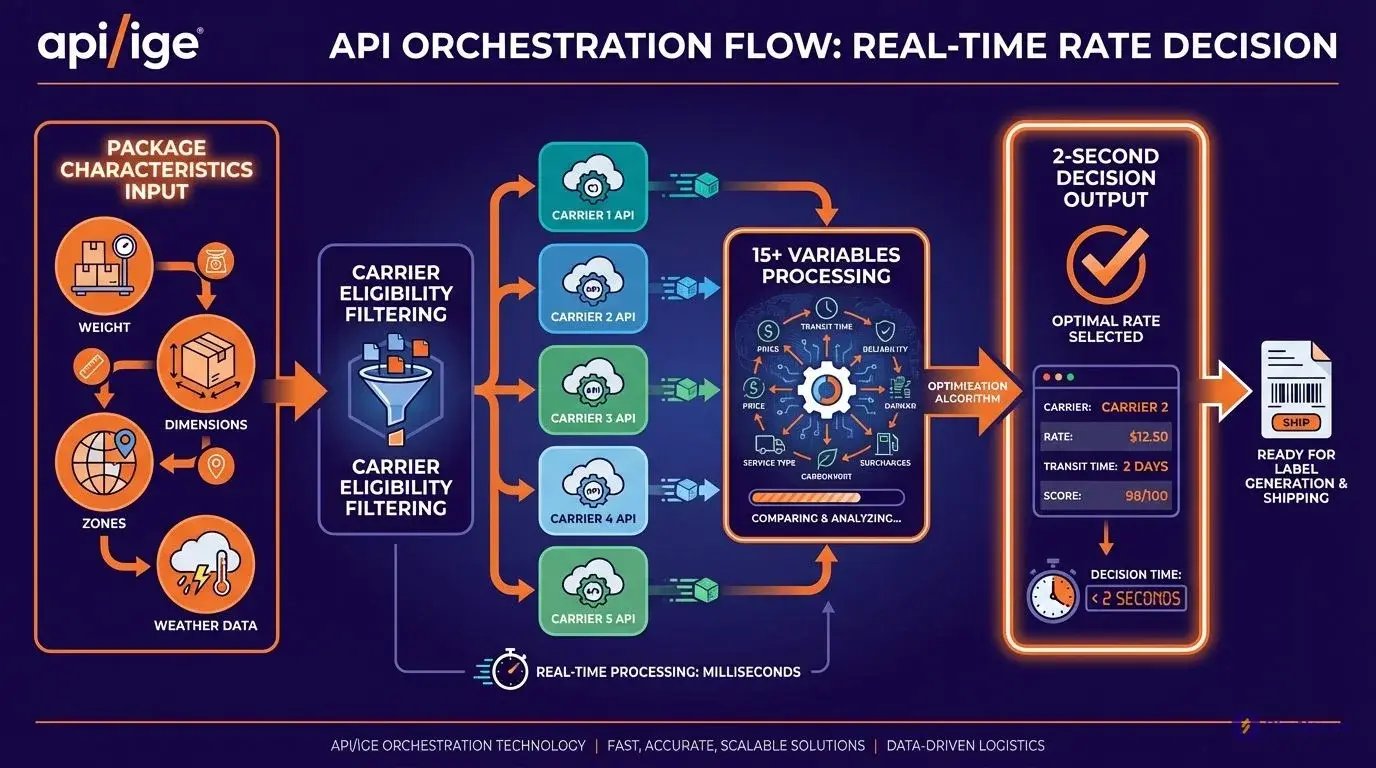
Modern carrier rate comparison operates through API orchestration that queries 5-7 carriers simultaneously, processing 15+ variables per shipment in under 2 seconds. Weight, dimensions, zones, surcharges, delivery promises, and business rules all factor into real-time decisions that manual processes can't match.
The decision logic reveals why speed matters. Package characteristics trigger carrier eligibility - 75-pound shipments eliminate USPS, hazmat requires certified carriers. Delivery requirements filter options - next-day to rural Montana leaves only FedEx Express. Cost optimization evaluates base rates plus surcharges within eligible carriers.
Real-time data feeds power these calculations. Carrier APIs update rates 4-6 times daily. Weather services flag delays. Historical performance predicts delivery success. The orchestration layer synthesizes inputs and returns optimized selection before warehouse systems timeout. Processing delays cascade through operations - a 2-second carrier selection that stretches to 30 seconds forces warehouse staff to wait, creating bottlenecks that compound across thousands of daily shipments.
Why Manual Rate Shopping Fails at Scale
Calculate the impossibility. Three minutes per shipment times 50,000 monthly packages equals 2,500 hours - over 15 full-time employees just comparing rates. Rates change 4-6 times daily across carriers, making morning comparisons obsolete by lunch. Excel-based comparison misses 30% of applicable surcharges because humans can't track every residential fee, extended area surcharge, and fuel adjustment across multiple carriers simultaneously.
Advanced Strategies Only 5% of Companies Use
Once you have this technical foundation in place, you can implement strategies that most companies don't even know exist. These are the tactics that separate good from great.
Zone skipping drives long-distance shipping cost optimization. The real opportunity lies in consolidation: gather packages by destination region, ship via LTL to a forward hub, then inject into local delivery networks. One retailer cut their average Zone 8 cost by 35%. This principle extends to any shipment traveling more than 1,000 miles.
Weather-based routing switches carriers preemptively based on predicted conditions. Memphis FedEx hub delays 73% of packages during ice storms, while UPS Louisville maintains 94% on-time performance. The algorithm tracks weather forecasts 72 hours out, routing around predicted storm paths. Most teams get this wrong by reacting to delays instead of preventing them.
Dynamic carrier selection operates on package-level intelligence. A package destined for Zone 8 might earn a volume discount with your primary carrier and still land above a competitor's zone-skipped option. The math is simple: sacrifice the small volume discount to capture the larger routing savings.
What Is Hidden in Your Carrier Contracts
Carriers structure volume incentives to encourage overspending. Your FedEx contract promises 2% savings at 100% volume compliance. But 20% of your shipments route better through UPS - saving 8% on those specific packages. Forcing that 20% through FedEx costs you 8% more while your 2% contract savings applies to all shipments. Net result: 6% overpayment on 20% of shipments. The typical enterprise runs 3-5 carrier contracts simultaneously.
Industry-Specific Implementation Playbooks
Most teams approach rate shopping shipping with generic solutions that ignore industry-specific constraints. Vertical-specific optimization addresses unique compliance, delivery, and operational requirements.
Healthcare shipping requires HIPAA-compliant carrier selection integrated with temperature monitoring APIs. Smart systems query only pre-certified carriers, then layer real-time temperature data into routing decisions. A pharmaceutical distributor reduced temperature excursions by 67% while cutting costs 18% by selecting carriers with proven performance in extreme heat corridors. HIPAA compliance demands encrypted transmission and automated PHI redaction.
Fashion retail profits from delivery segmentation matching customer expectations to geography. Metropolitan areas generate 65% of orders but only 30% of shipping distance. Same-day delivery through local courier integration undercuts same-day through traditional carriers. Systems geofence urban cores for courier routing while switching rural orders to economy services.
B2B manufacturing breaks consumer shipping rules with palletized freight and dock appointments. Optimization logic works backwards from delivery requirements - querying appointment availability first, then finding carriers meeting required windows. LTL optimization requires modeling true all-in costs including accessorial charges that triple base rates. One manufacturer discovered their preferred LTL carrier charged 300% more for residential deliveries, and moved those shipments to competitors.
The 30-Day Implementation Roadmap
You've seen what's possible. Now let's get practical about making it happen in your organization without disrupting operations.
The timeline to operational shipping rate shopping surprises most executives. Full implementation takes 30 days from data analysis to scaled deployment. Not 6 months. Not a year of committee meetings. Thirty days to transform shipping from fixed cost to strategic variable.
Week 1: Download 90 days of shipping data from your current system. The analysis reveals patterns invisible in daily operations. Most companies discover 15-25% savings potential within 48 hours. One manufacturer found savings hidden in Zone 7 shipments that could route through regional carriers.
Weeks 2-3: Modern carrier APIs connect in 3-5 days of development work. The remaining time handles configuration and testing. Business rules encode your shipping logic - which carriers handle hazmat, weight thresholds, zone preferences.
Week 4: Route 10% of volume through the new system while maintaining current processes. This controlled pilot measures real performance against projections. Most pilots exceed savings estimates - the 15% projection becomes 18% reality.
Week 5+: Scale intelligently in 25% increments. Monitor carrier performance as volumes shift. Full deployment typically happens by day 30.
Week 1: The Opportunity Audit
Export your shipping data to CSV - every field matters. Calculate average costs by zone to expose geographic inefficiencies.
The 80/20 rule applies viciously to shipping. Your top 20% of lanes represent 80% of spend. Focus here first. Run what-if scenarios showing savings from optimizing just these lanes. The numbers typically shock executives into immediate action.
What Your CFO Needs to Know
The numbers make the decision obvious. Implementation covers software licensing, integration, and training. Cost reduction across shipping spend averages 15-20%. Payback period? Three weeks until you're generating pure profit from shipping cost optimization.
Risk mitigation follows a proven sequence. Start with low-value shipments where delivery hiccups won't trigger executive escalations. Route 10% of volume through the new system while maintaining existing processes. Carrier relationships remain intact because you're optimizing distribution, not abandoning partners.
The strategic value extends beyond cost savings. Peak season shipping capacity becomes manageable when you're not locked into single-carrier dependence. Last December, companies with multi-carrier systems maintained 95% on-time delivery while single-carrier shippers hit 78%.
The technology risk disappeared years ago - this is proven infrastructure generating predictable returns. Companies moving first capture market advantage while competitors debate implementation timing.
Frequently Asked Questions
How long does implementation typically take?
Most companies complete full deployment in 4-6 weeks. The first week covers system integration and carrier API connections. Weeks 2-3 focus on business rule configuration and user training. The final weeks involve testing with low-risk shipments before scaling to full volume.
What ROI can we expect in the first year?
Conservative projections show 300-400% ROI within 12 months. Implementation cost is typically recovered in 3-4 weeks through immediate shipping savings.
Will this damage our existing carrier relationships?
Rate shopping strengthens carrier partnerships by distributing volume more strategically. Carriers prefer predictable volume flows over feast-or-famine allocation. You're optimizing service matching, not threatening loyalty contracts. Most carriers actually increase their win rates when competing on service quality rather than just price.
How does the system integrate with our current ERP and WMS?
Modern rate shopping platforms connect through standard APIs that work with 95% of existing systems. Integration typically requires no custom coding - just configuration of data flows and business rules. Your existing shipping workflows remain unchanged from the user perspective.
Can we customize business rules for different product types or customers?
Advanced rule engines handle unlimited complexity. Set different carrier preferences for fragile items, expedited shipping for VIP customers, or cost optimization for bulk orders. Rules can factor in delivery zones, package dimensions, seasonal capacity, and customer-specific requirements.
What happens during carrier outages or service disruptions?
The system automatically reroutes shipments to backup carriers when primary options become unavailable. Real-time monitoring detects service interruptions and applies failover rules within minutes. This redundancy actually improves delivery reliability compared to single-carrier dependence.
How do we handle returns and customer service issues across multiple carriers?
Unified tracking dashboards consolidate all shipment data regardless of carrier. Customer service teams access complete shipping history through a single interface. Return processing follows the same optimization logic - selecting the most cost-effective return path while maintaining service standards.
Ready to Transform Your Operations?
See how SkuNexus gives you full control over inventory, orders, warehouse, and shipping.
Schedule a Free Demo →
Keep Reading