The Returns Problem Sitting in Your Warehouse
Most teams get this wrong by treating returns as an inevitable cost rather than a profit leak they can plug.
Here's the math that should keep you up at night: every returned item destroys 20-65% of its original value through processing, restocking, and markdown losses.
Calculate your burn rate right now. Multiply your monthly return volume by your own per-return handling cost, before accounting for lost product value or fraud. You can't afford to keep bleeding cash through unsystematized returns.
Your 5-Step Returns Processing Workflow (With Time Targets)
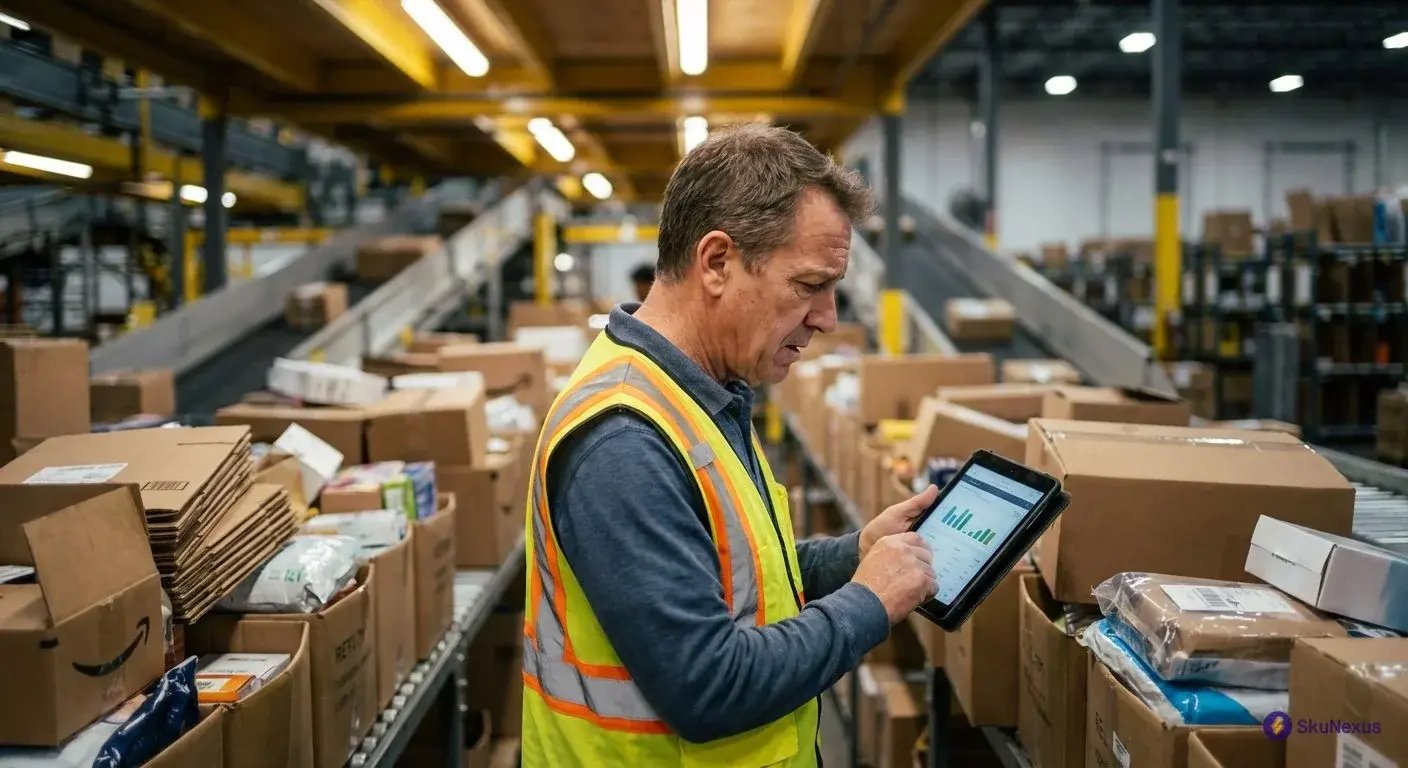
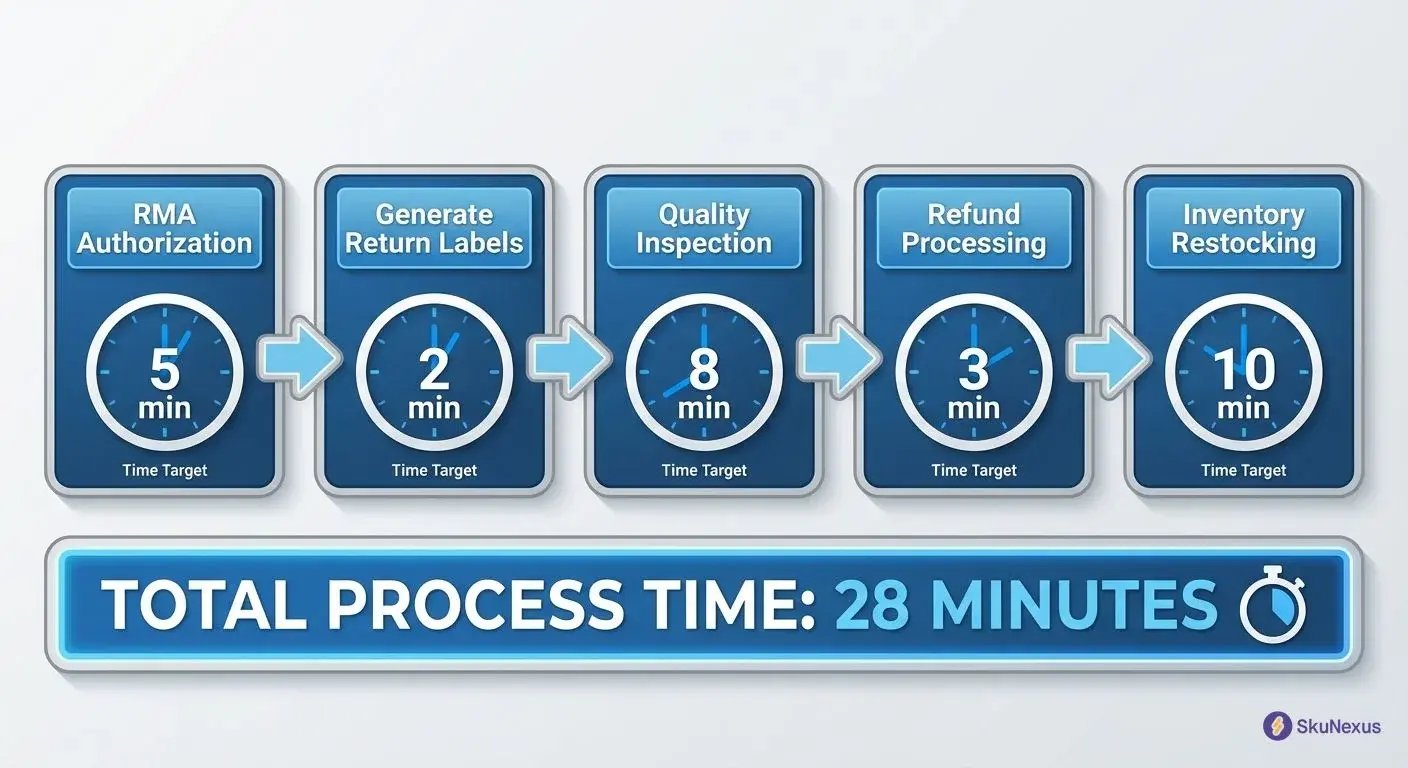
Twenty-eight minutes. That's your target for processing each return from RMA to restocking. Most operations take 45-90 minutes per item, bleeding efficiency through unstructured workflows. At 1,000 returns monthly, hitting this target saves 1,033 labor hours.
Map these five steps with military precision: RMA generation (5 minutes), shipping labels (2 minutes), inspection (8 minutes), refund processing (3 minutes), restocking (10 minutes). Miss these targets and your returns process becomes a profit sinkhole.
This timeline isn't aggressive - it's competitive reality when Amazon processes returns in 15 minutes.
Step 1: RMA Authorization (5 Minutes Max)
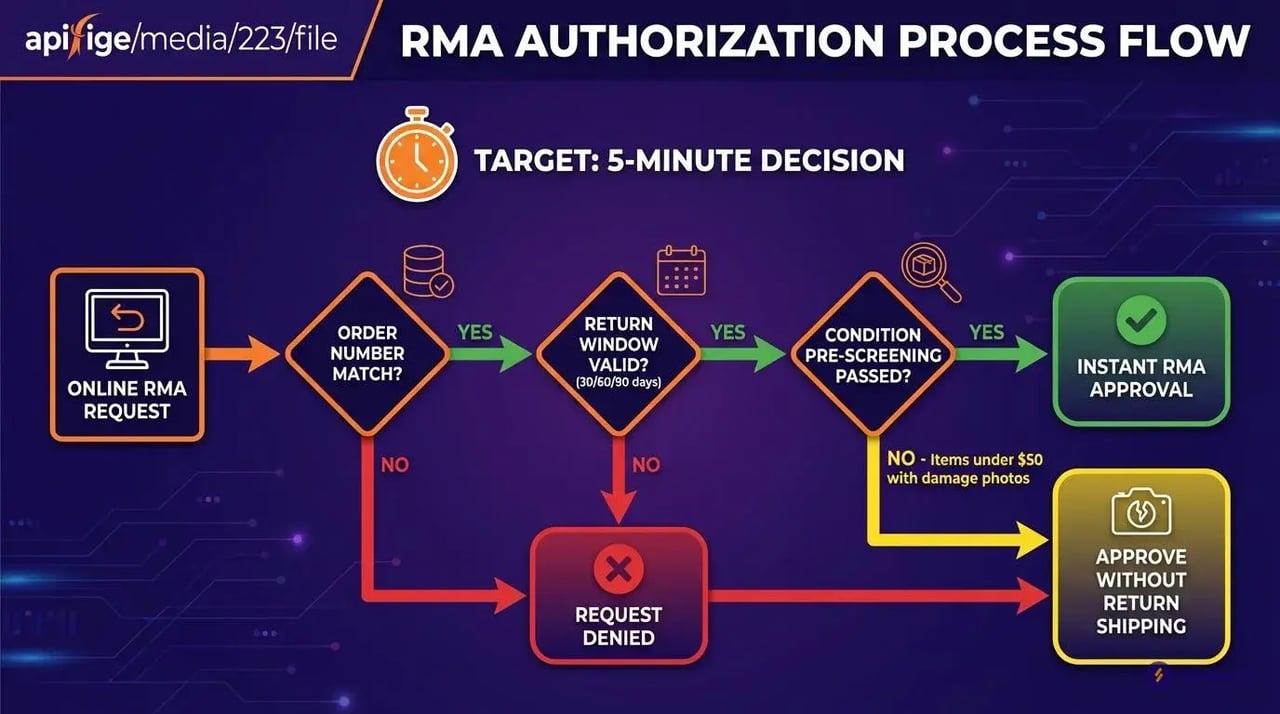
Your 3-point verification system determines profitability before the return ships. First: order number match against your database. Second: return window validation - 30 days for electronics, 60 for apparel, 90 for furniture. Third: condition pre-screening through customer photos.
Green-light instant approvals when all three points pass. Items whose return shipping costs more than you would recover on resale, with clear damage photos? Approve without return shipping. This triage processes 70% of RMAs instantly while catching the 30% that destroy margins.
Step 2: Generate Return Labels in Bulk (2 Minutes Each)
Batch processing transforms label generation from tedious task to automated flow. Queue 50 RMAs and generate labels simultaneously through carrier APIs. Your reverse logistics strategy offers three options: prepaid labels for standard items, drop-off locations for urban customers, scheduled pickup for items over 50 pounds.
Rate shopping between carriers saves 15-30% on return shipping costs.
Step 3: Quality Inspection (8 Minutes Max)
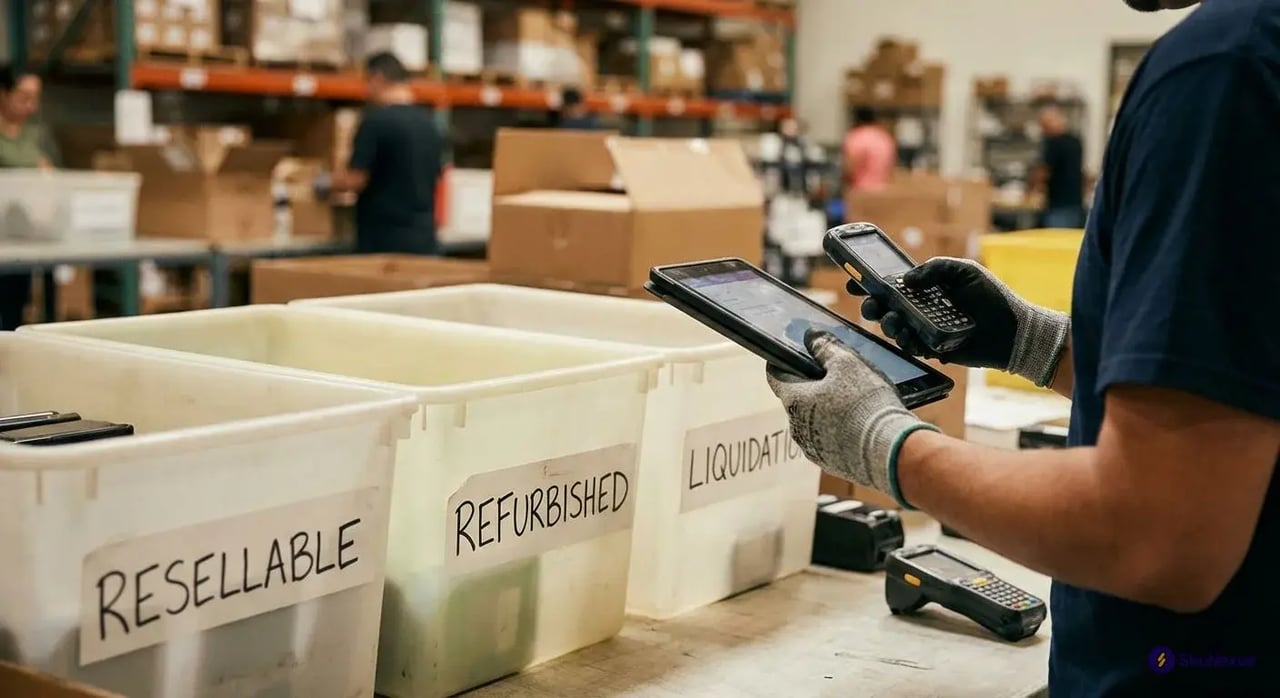
Sort returns into three buckets: resellable as new, refurbished stock, or liquidation. Electronics get functionality tests. Apparel requires damage assessment and cleaning evaluation. This sorting determines your recovery rate.
Step 4: Refund Processing (3 Minutes Each)
Automate refunds for approved returns through payment gateway APIs. Partial refunds for missing accessories or damage follow predetermined matrices. Speed here drives customer satisfaction scores.
Step 5: Inventory Restocking (10 Minutes Final)
Update inventory systems, assign new SKUs for refurbished items, and route products to appropriate warehouse zones. This final step closes the loop on your returns process.
7 Returns Management Tactics That Actually Move the Needle
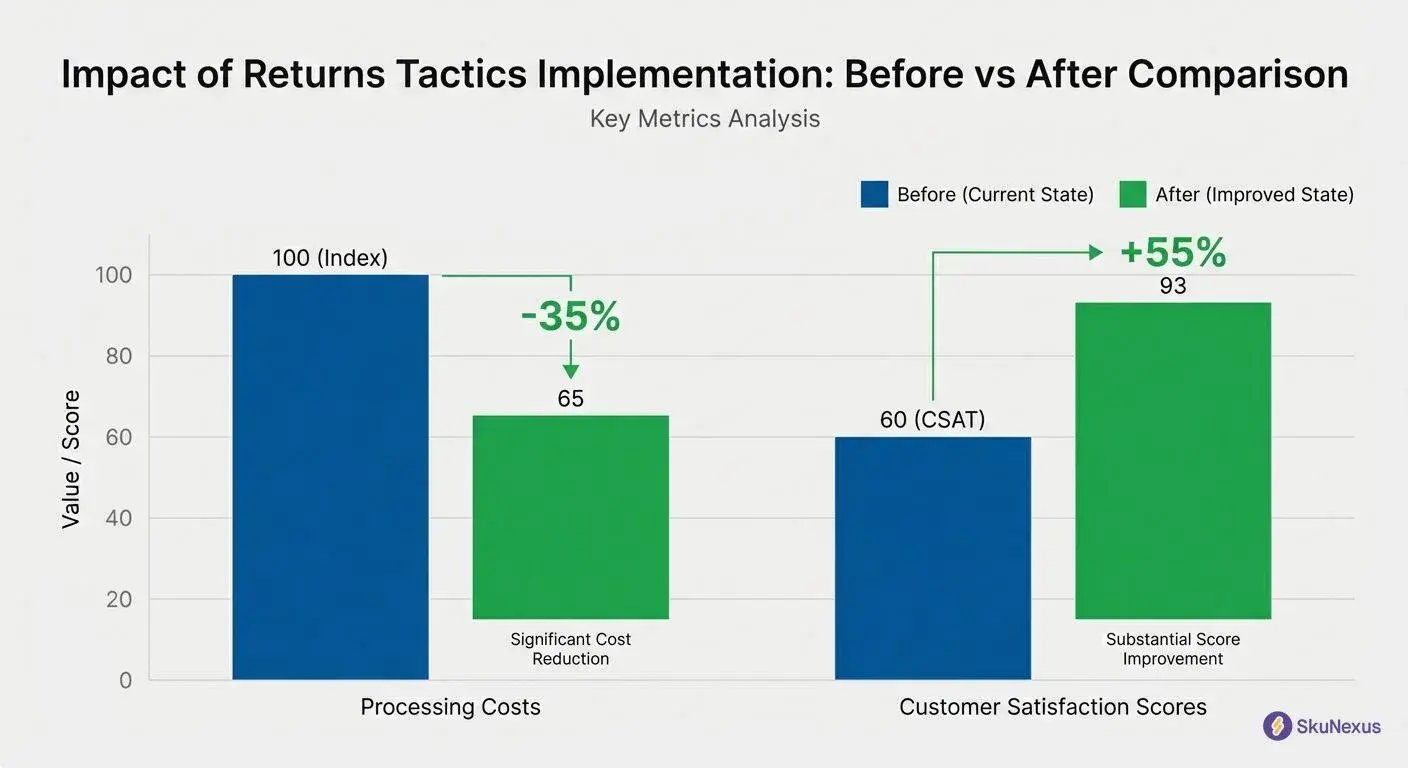
Most returns policies fail because they ignore warehouse execution. These seven tactics cut processing costs by 35% while improving customer satisfaction scores by transforming returns from reactive damage control into predictable profit recovery.
1. Write a Returns Policy That Prevents Problems
Your returns policy needs five sections that preempt 90% of disputes. Create an eligible items list with clear exclusions - consumables, customized products, and clearance items marked "final sale." Implement category-based return windows: 30 days for electronics, 60 for apparel, 90 for furniture. Document condition requirements with actual photos showing acceptable wear versus damage that voids returns.
The fee structure determines profitability. Charge nothing for defective items, a flat restocking fee for buyer's remorse, and a higher fee for anything requiring special handling. Offer three refund paths: original payment method, store credit with 10% bonus, or immediate exchange. Place this policy in four locations: product pages above the fold, shopping cart as a link, checkout confirmation screen, and order confirmation emails.

2. Build a Self-Service Portal That Handles 80% of Returns
Six portal features eliminate human touchpoints while improving satisfaction. Order lookup by email takes 10 seconds. Reason selection with mandatory photo uploads catches fraud before shipping. Instant RMA generation with barcode prevents duplicate returns. Label printing directly from the portal saves 5 minutes per return. Tracking updates every 4 hours reduce support tickets by 60%. Automated refund triggers based on scan events eliminate manual processing delays.
Target 80% of returns completed without agent intervention. The returns process becomes predictably scalable, and the cost per transaction falls with it.
3. Track These 5 Metrics Weekly (Not Monthly)
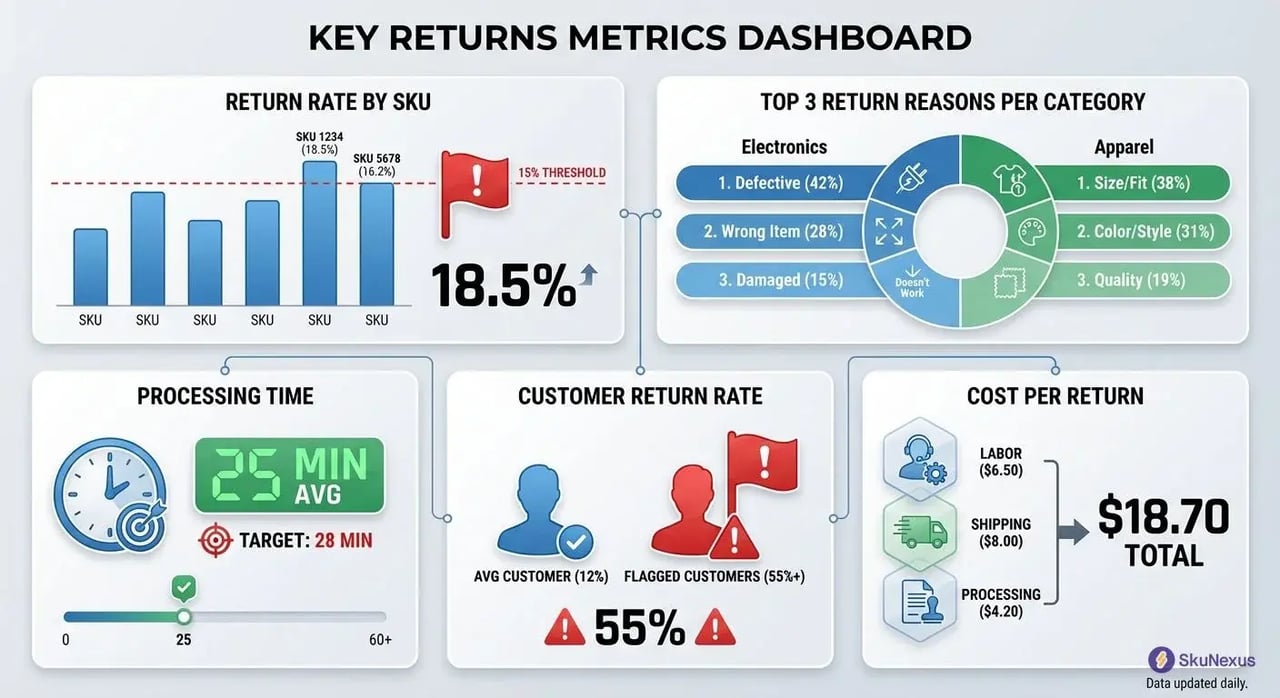
Weekly tracking catches trends while you can still intervene. Monitor return rate by SKU with automatic flags for anything exceeding 15%. Track top three return reasons per product category - "doesn't fit" means size chart problems, "not as described" indicates listing issues.
Processing time per return reveals operational bottlenecks. Target 28 minutes total: 5 minutes for receipt scanning, 8 for inspection, 3 for refund processing, 12 for restocking. Cost per return including labor, shipping, and processing fees exposes your true burden. Flag customers returning over 50% of orders for manual review.
4. Create 3 Return Routes Based on Item Value
Route economics determine profitability. Your cheapest items follow the "keep it" path - instant refund without return shipping - because return shipping, processing and restocking together cost more than the item recovers.
Mid-range items demand standard processing with inspection checkpoints. They justify the return cost because you recover 60-80% of value through resale. Your highest-value items trigger enhanced protocols: signature-required return shipping, video documentation during unpacking, and fraud verification. These reverse logistics best practices prevent the "empty box" scams that plague high-value categories.
5. Send 4 Automated Updates That Reduce Support Tickets
Each update prevents 25% of support contacts. Update 1 fires upon RMA approval: "Return approved! Label attached. Ship within 7 days." Update 2 triggers on facility scan: "Package received at 2:47 PM EST. Inspection begins within 24 hours."
Update 3 communicates the decision: "Inspection complete. Refund approved. Missing accessories deduction applied." Update 4 confirms completion: "Refund processed to Visa ending 4242. Allow 3-5 business days."
6. Stop Returns Before They Happen
Size charts need actual garment measurements in inches, not arbitrary S/M/L designations. Measure chest, waist, hips, sleeve length, and total length for every size. Add fit notes: "runs small" or "athletic cut." This cuts size-related returns by 35%.
Implement 360-degree product views showing every angle. Mandate customer photos in reviews - real people wearing real products. Fashion retailers implementing virtual try-on report 64% fewer fit-related returns. Electronics sellers using compatibility checkers see 40% reduction in compatibility issues. These ecommerce returns management improvements pay for themselves within 90 days.
7. Turn Returns Into Profit Centers
Three disposition channels maximize recovery value. Grade A items (95%+ condition, all packaging) resell at 90% of original price through your main channel. Grade B products (80-94% condition, missing non-essential packaging) bundle into "open box" deals at 60-75% pricing.
Grade C inventory (60-79% condition, functional but cosmetically flawed) flows to liquidation partners at 20-30% recovery rates. This systematic approach transforms returns from write-offs into a predictable revenue stream generating 15-25% margin recovery.
The 3 Returns Challenges Killing Your Margins (And Their Fixes)
Serial returners destroy 8-10% of your revenue while integration failures compound the damage through inventory chaos. International returns triple your domestic costs. These challenges exist. The only question is whether you'll implement controls to manage them.
Serial Returners and Wardrobing (Costing You 8-10% of Revenue)
Three flags expose serial returners before they decimate your margins: return rates exceeding 50% across any 90-day window, multiple size orders on single transactions, and returns within 7 days of major events. These behaviors signal wardrobing intent, not legitimate shopping.
Implement controls that protect profitability without alienating good customers. Limit accounts to 3 returns per 90-day rolling period after they trigger two flags. Require tags remain attached for full refunds - remove the tag, forfeit 50% of value. Add a 15% restocking fee for customers exceeding the 50% return threshold. These returns management tactics cut wardrobing losses by 60% within the first quarter.

Integration Nightmares Between WMS and Returns Systems
Five integration points determine whether your ecommerce returns management runs smoothly or hemorrhages cash: inventory updates within 2 hours of return scan, automatic credit hold releases upon inspection completion, real-time availability adjustments for Grade A returns, daily financial reconciliation, and customer account history syncing across all touchpoints.
Your API evaluation needs six non-negotiables: REST architecture, webhook support for real-time events, bulk operations handling 10,000+ transactions, error handling with automatic retry logic, sandbox environment for testing, and developer-focused documentation. Any vendor missing two or more fails the integration test.
International Returns Eating 3X Domestic Costs
Zone-based strategies transform international returns from profit destroyers into manageable expenses. Zone 1 covers domestic returns with standard process. Zone 2 encompasses Canada and Mexico where partnering with local 3PLs cuts costs by 40%. Zone 3 requires mathematical precision - calculate true landed costs including original shipping, return shipping, duties, and processing fees.
Implement keep-it policies for the items where the return math never works. Mid-value items get return authorization only for defects. Your highest-value items justify full return processing. Country-specific instructions prevent customs nightmares: UK returns need CN23 forms, EU shipments require proof of original export, and Japanese customers expect prepaid return slips.
Your Returns Tech Stack: 4 Systems You Actually Need
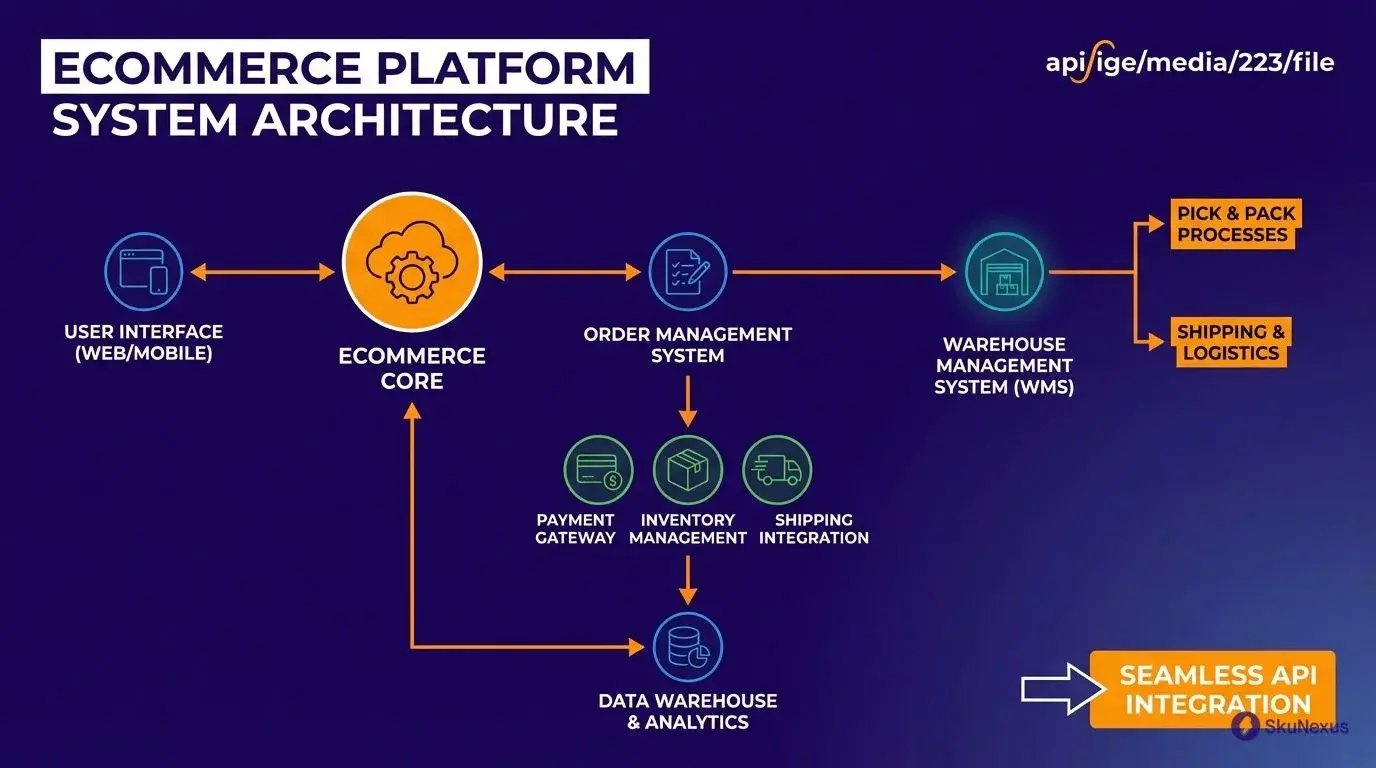
Vendor hype promises magical returns automation. Reality? Most mid-market operations need four core systems, not forty. Skip the buzzword-laden platforms. Focus on integrations that deliver measurable ROI within 12 months while supporting your returns management best practices.
Calculate your technology break-even before signing contracts. Work out your own annual returns handling cost, then work out what cost reduction a platform has to deliver against that number before you sign. Most platforms promise 40-50% reductions - if you choose systems that actually integrate.

Returns Management Platform (Not Just RMA Software)
Six features separate profit-generating platforms from expensive spreadsheet replacements: automated routing rules, multi-carrier integration, inspection workflows with photo capture, disposition management, analytics dashboards, and API-first architecture.
Implementation takes 6 months. ROI arrives at month 12 when automated routing cuts the per-return cost through optimized carrier selection.
When to Outsource to a 3PL (The 10,000 Return Rule)
Math determines outsourcing decisions. Processing over 10,000 returns annually? Returns exceeding 15% of forward shipments signal operational strain requiring specialized reverse logistics.
Transition takes 90 days: vendor selection, systems integration, parallel operations. Choose providers offering real-time visibility and month-to-month terms after initial contracts.
Making Returns Sustainable Without the Greenwashing
Sustainability metrics without measurement equals marketing fluff. Environmental concern means nothing without quantifiable carbon reduction that maintains profitability.
Consolidation transforms returns from daily dribbles into weekly waves. Hold returns for 5-7 days, then ship consolidated containers. One truck replacing thirty vans cuts emissions by 85% and cuts the per-return cost with it.
Grade C items deserve better than landfills. Partner with local donation centers for tax-deductible disposal of functional inventory. Track donation value for Section 170 deductions worth 15-30% of wholesale cost.
Biodegradable packaging pays for itself through weight reduction. Corrugated mushroom packaging weighs 60% less than traditional materials, cutting shipping cost per return. Initial cost premium recovers within 6 months.
Carbon tracking requires three measurement points: transportation emissions (1.2kg CO2 per zone), processing energy (0.3kg CO2 per return), and final disposition transport (0.8kg CO2 average). Set quarterly reduction targets of 5% through route optimization and facility efficiency.
Your Next 90 Days: Returns Transformation Roadmap
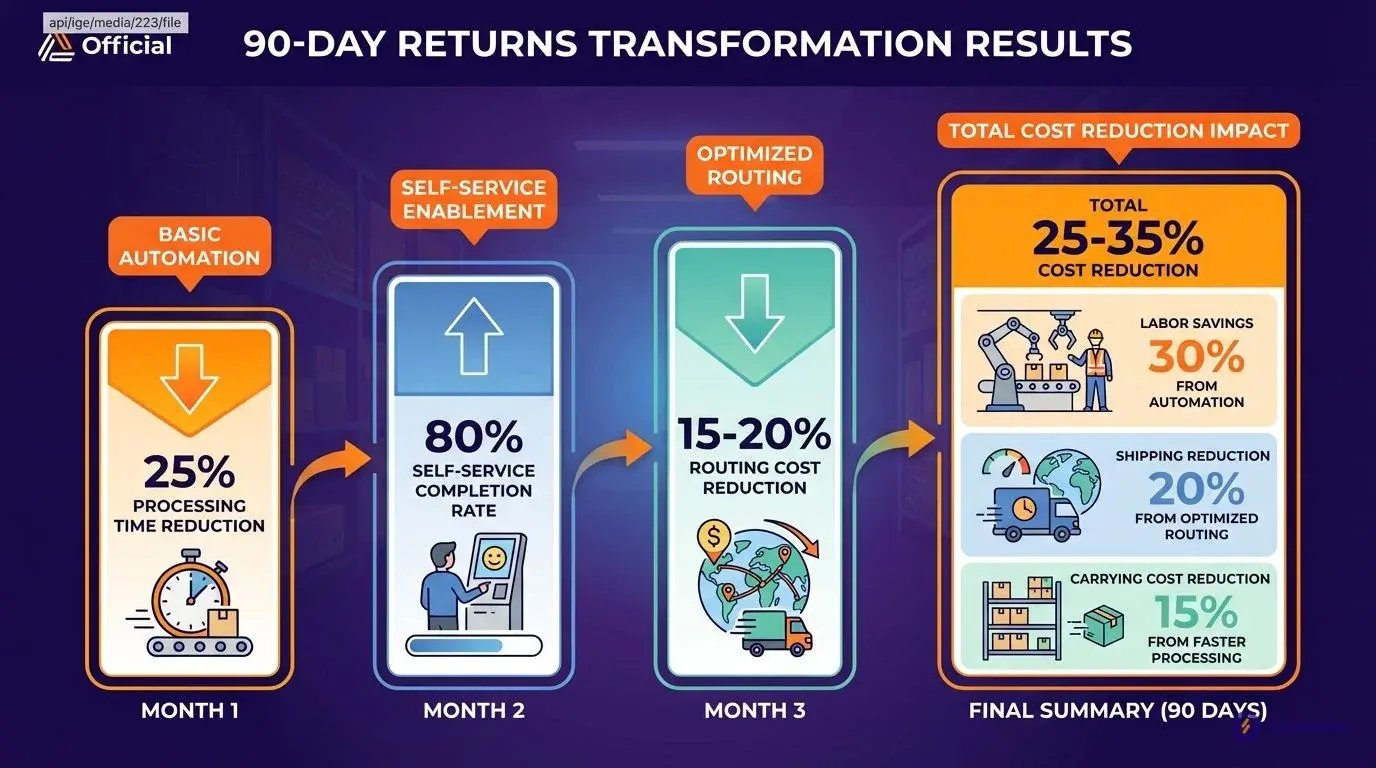
Month 1 starts with brutal honesty. Audit your current process with a stopwatch - most teams discover they're burning 40% more than estimated. Identify your top 3 problem SKUs by return rate and margin impact. That bestselling dress with 35% returns likely accounts for 30% of your burden. Fix these first through better descriptions or packaging improvements. Implement basic automation: automated RMA generation, return reason codes, and rule-based routing. This foundation cuts processing time by 25%.
Month 2 launches self-service revolution. Deploy a returns portal targeting 80% completion without human intervention. Train teams on new procedures focused on exceptions, not routine processing. Establish vendor partnerships for consolidated shipping and liquidation agreements. These returns management best practices transform one-off negotiations into systematic value recovery with predetermined disposition paths.
Month 3 integrates analytics with optimization. Track cost per return by SKU and segment. Optimize routes using actual data - zone-skipping for high-volume corridors, consolidation for international returns. This typically yields 15-20% cost reduction through routing alone.
The compound effect delivers 25-35% total cost reduction: automation saves 30% on labor, optimized routing cuts shipping by 20%, faster processing reduces carrying costs by 15%.
This principle extends to continuous improvement beyond 90 days. Quarterly reviews examine new problem SKUs and emerging patterns. Each quarter should deliver 5-10% additional improvement through systematic optimization.
For operations ready to scale beyond manual processes, platforms like SkuNexus provide the automation backbone that transforms returns from cost centers into competitive advantages.
Ready to Transform Your Operations?
See how SkuNexus gives you full control over inventory, orders, warehouse, and shipping.
Schedule a Free Demo →
Keep Reading